Finally, the moment has come. The day is here. It is Friday, July 26, 2024, and tonight’s the night of the Olympic Opening Ceremony.
No, wait. We’re not there yet. In the morning, France wakes up to reports of arson attacks on the French high-speed railway during the night. Chaos ensues, and reportedly, some spectators who paid a fortune for their Opening Ceremony seats (tickets cost over 1,000 euros) didn’t make it in time.
But now for real! We’re on the Seine river, it is Friday evening, and I give you—
RAIN!
Yes, thousands and thousands of spectators sit in temporary stands along the river between Austerlitz and Iéna bridges, and it’s pouring down on them. Also on the artists, the VIPS, the security people, and most importantly, on the Olympic athletes in their boats!
I watched a documentary later, and Tony Estanguet, head of the organizing committee and three-times Olympic champion, had tears in his eyes. He’d weathered everything, the arguments, the delays, the politics, and now just as his dream was coming true, the weather gods punished him.
Meanwhile, my family had the very best seats in the house: in front of the TV!
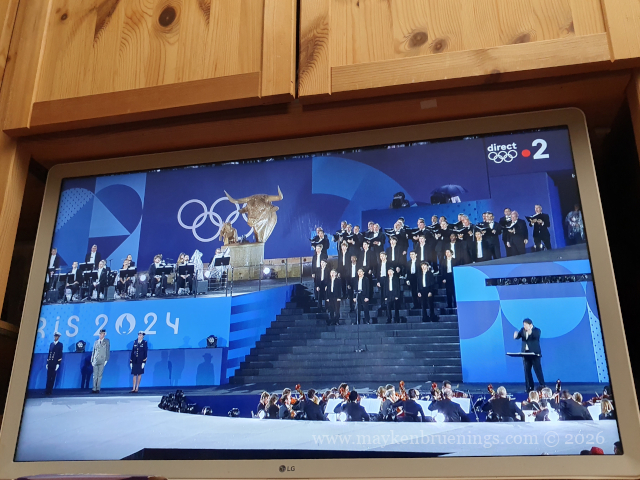
You see, the idea of holding the Opening Ceremony on the Seine meant that each spectator only saw a small part “live” and had to follow the rest on one of the big screens. Also, they were being rained down upon. Whereas we were sitting in our warm and dry living room, hadn’t spent a cent on tickets for the night, yet got the very best view.
Many Parisians had applied for free tickets, but those were obviously behind the 1,000-euro-seats and, just as obviously, in the rain.
I don’t regret anything about that night.
The Opening Ceremony changed everything. From the moment the French national colors blue-white-red exploded on Austerlitz Bridge, still hours before the Games were declared open, the mood changed.
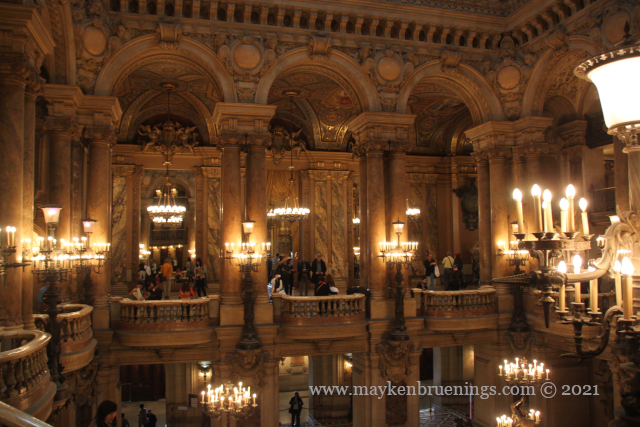
The ceremony was amazing. It started on a fun note, with comedian Jamel Debbouze (you might know him as architect Numerobis in “Asterix: Mission Cleopatra”) taking the Olympic torch to the Stade de France and finding it empty, only to have French football star Zinedine Zidane show up to save the day, racing with the torch into the métro. The métro (predictably) gets stuck, and Zizou tasks three kids with carrying the torch. They meet the Phantom of the Opera who rows them along an underground canal and onto the Seine. Later, a masked Assassin (from Assassin’s Creed, created in France) takes over and carries the torch over rooftops, checking in on rebuilt Notre Dame cathedral and rehearsals for Les Misérables musical. At one point, the torch is handed over to a cavalière on a silver horse named Zeus riding on the river to the Trocadéro. Only for more torchbearers to get in a speedboat and take the torch back to the Tuileries where the cauldron, a golden Montgolfière—a nod to History—is lit by an Olympian and a Paralympian.
Céline Dion rallies her voice to sing live from the Eiffel Tower, and a volunteer gets her fifteen minutes of fame holding the umbrella for organizing committee boss Tony Estanguet during his Opening Ceremony speech.
I was in tears in front of our TV screen. Skepticism? Forgotten. Let the Games begin!