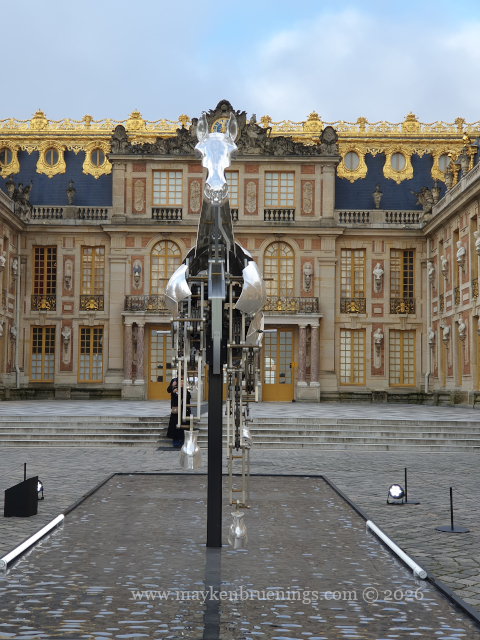
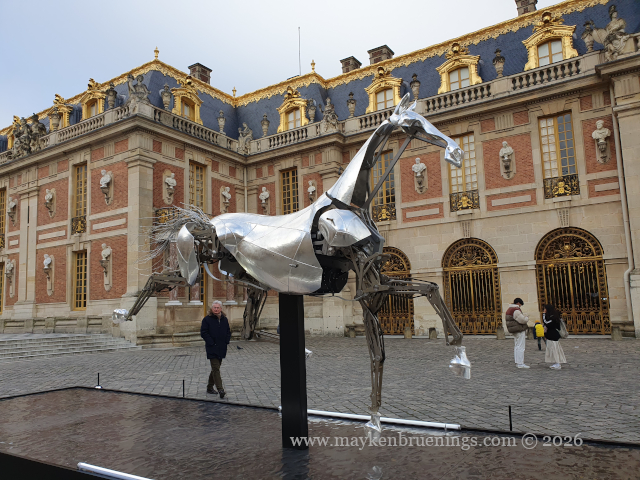
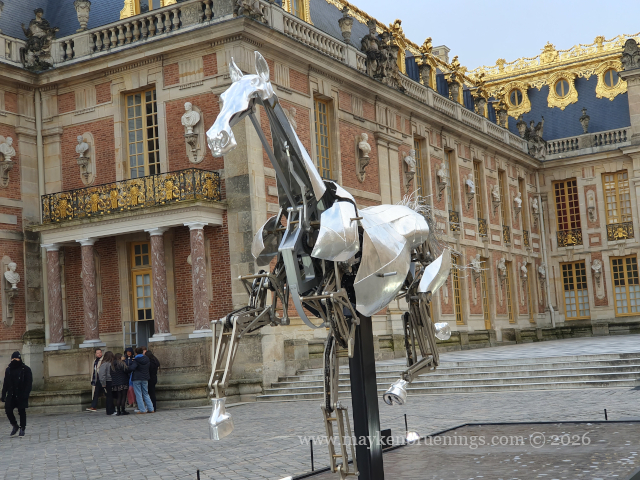
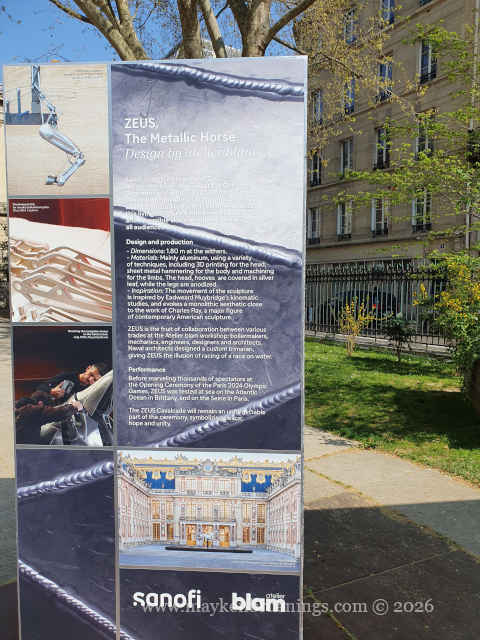
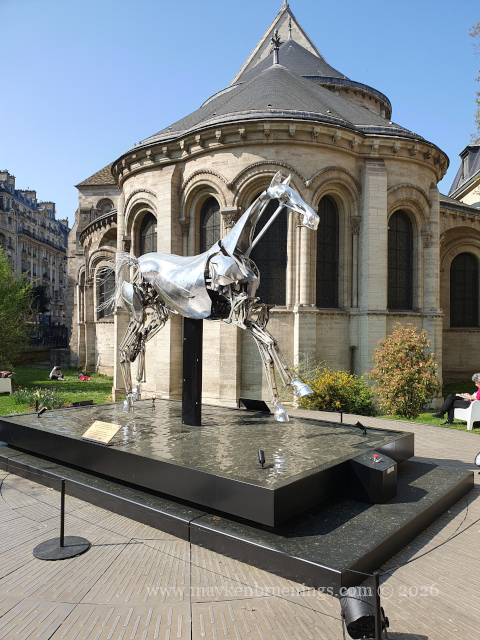
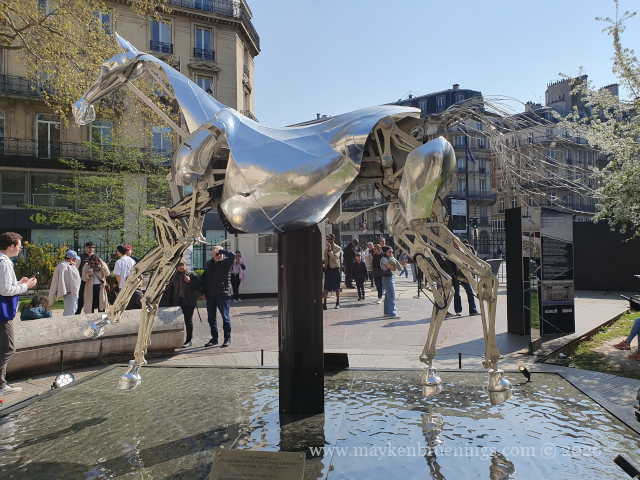
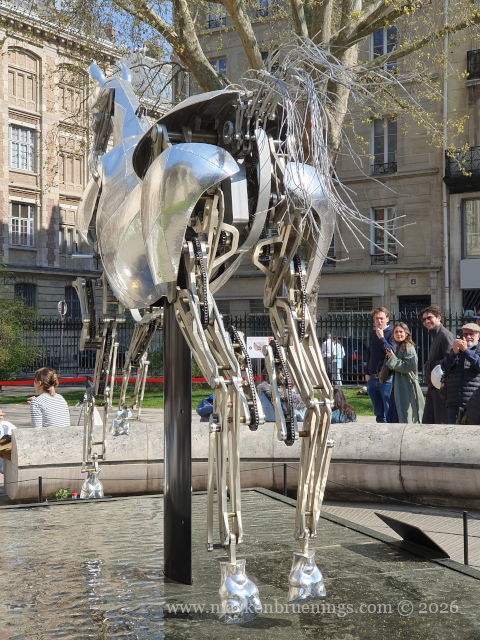
A few months later, in January 2025, we have a homestay guest from Canada. We take him to see the Château de Versailles, and who greets us in the courtyard? Zeus, the metal horse running along the Seine with its mysterious rider carrying the Olympic torch during the opening ceremony.
Zeus in the main courtyard of Versailles Palace
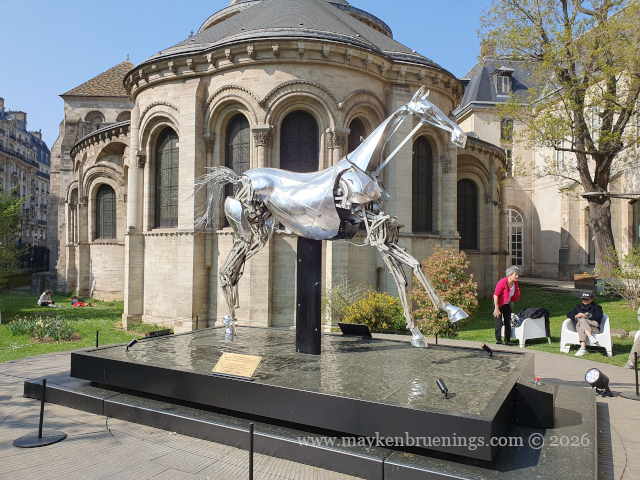
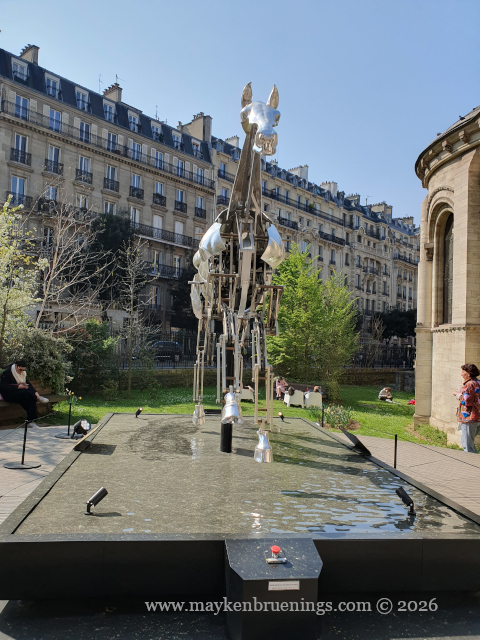
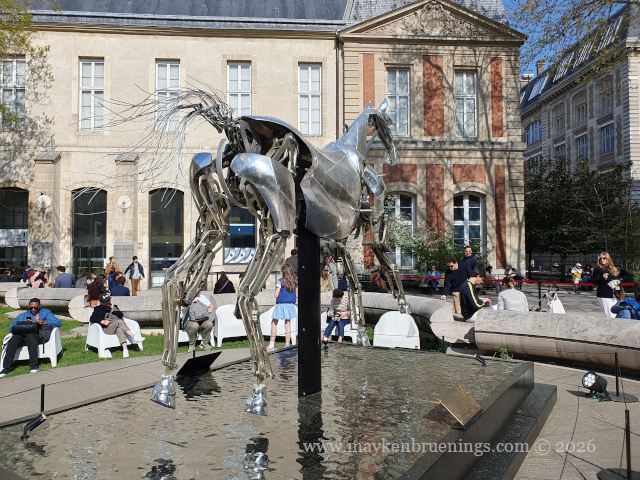
Over a year later, in spring 2026, we see Zeus again, in the Gardens of the Arts and Crafts Museum. And this time, he moves!
Zeus at the Musée des Arts et Métiers (Arts & Crafts Museum)
Paris 2024 may be over, but now we count the months until the 2030 Winter Games in the French Alps!
So what’s left of the Games once the show has really left town? Almost all the Games sites were either temporary structures like at Invalides or Concorde or repurposed existing sites like the Grand Palais or the Paris La Défénse Arena. Only the Olympics/Paralympic village and two arenas were built to last, the Arena Porte de la Chapelle (multisport) and the Aquatic Centre in Saint Denis.
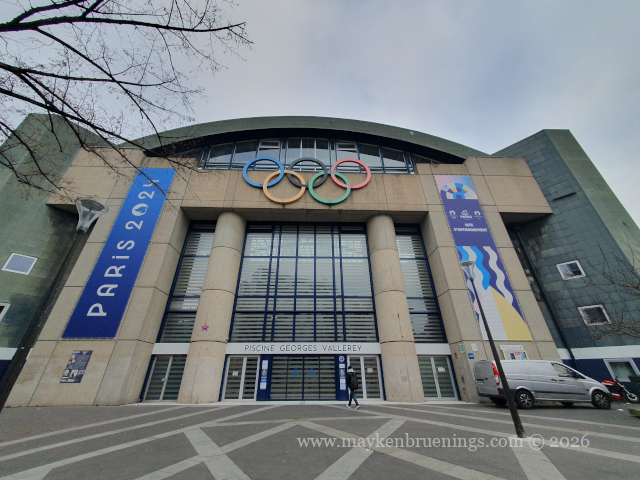
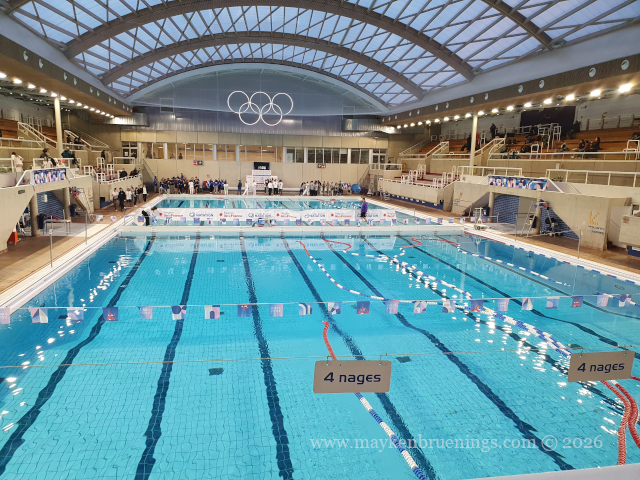
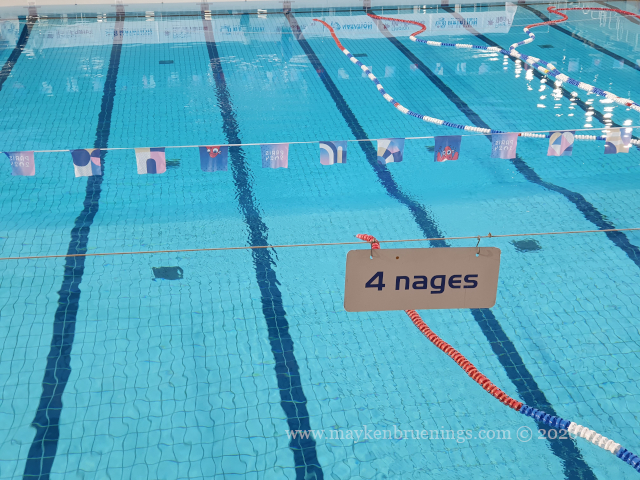
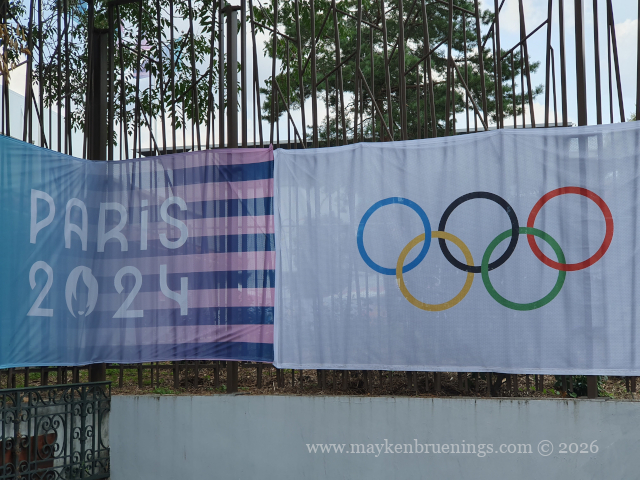
But some existing sites had been renovated ahead of the Games, such as the Grand Palais and the Stade Yves du Manoir (which already hosted the Paris 1924 Olympics!), and sites that served for training but not competition purposes, such as the Georges Vallerey Olympic-sized pool in the 20th arrondissement that months after the closing ceremonies still proudly showed off its Paris 2024 heritage.
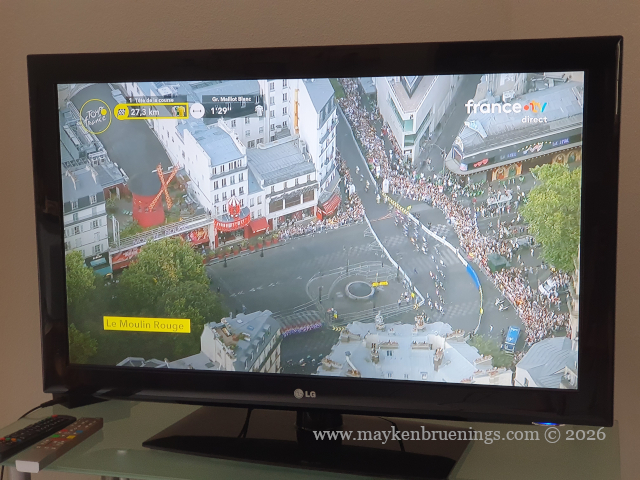
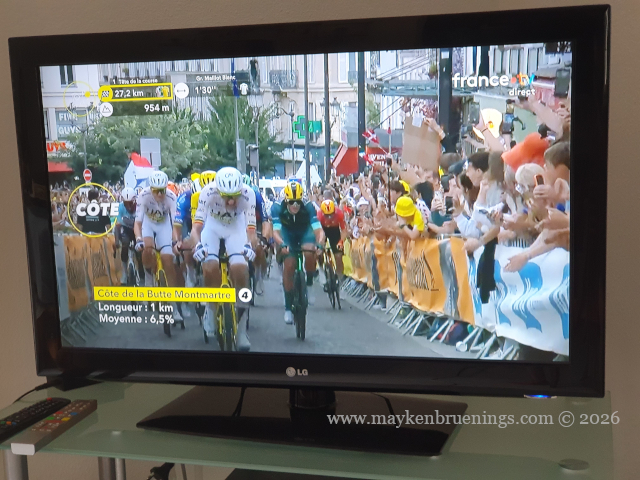
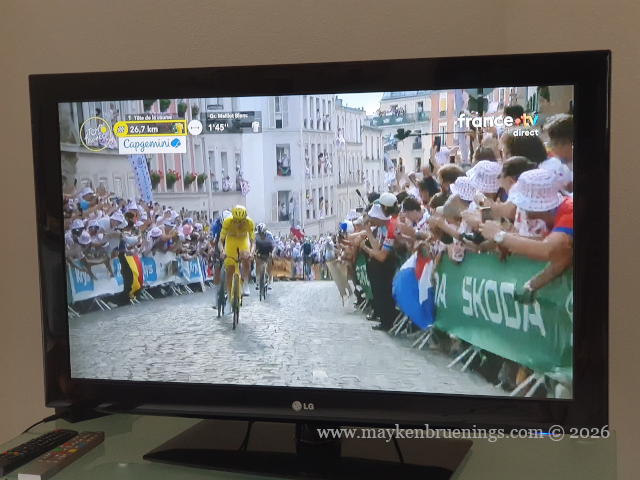
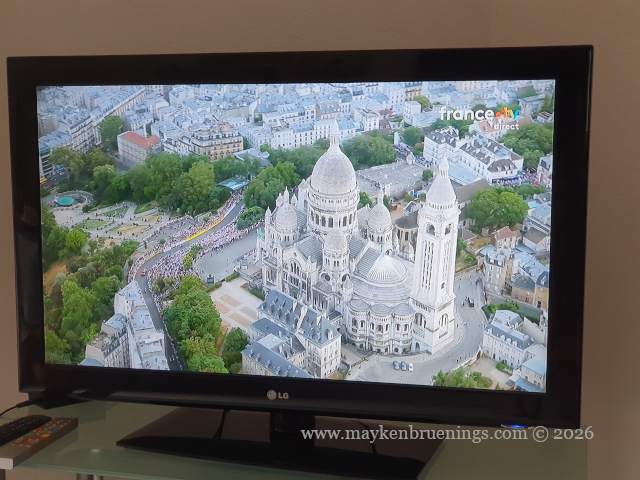
Also, the road bicycle race going through the steep narrow streets of Montmartre had been such a huge success that now the Tour de France includes it in the final stage, with the riders doing Montmartre-Champs Élysées circuits.
Live images taken on the tv during one of the Montmartre laps of the Tour de France 2026
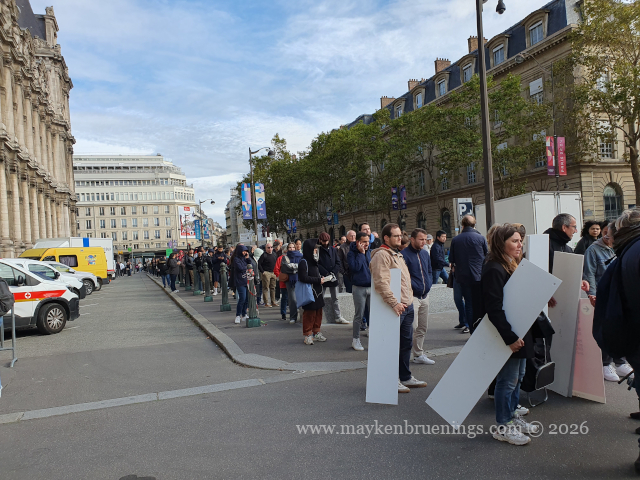
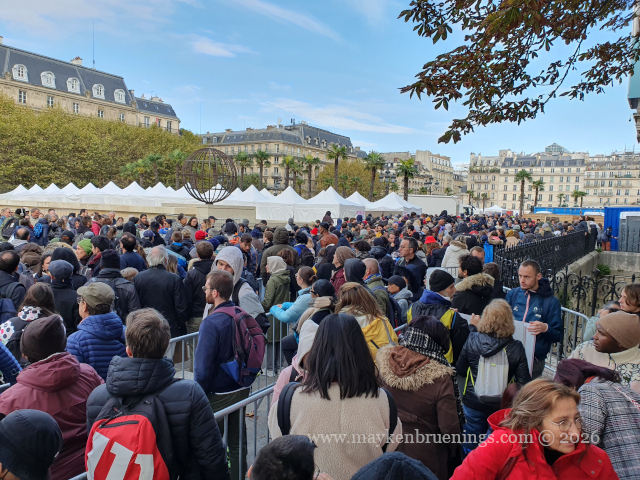
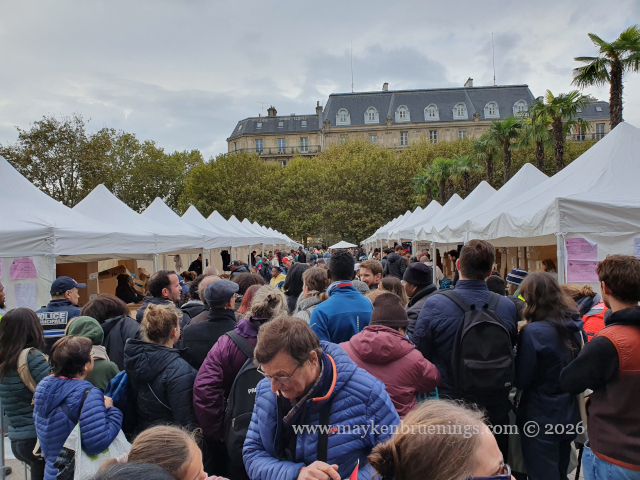
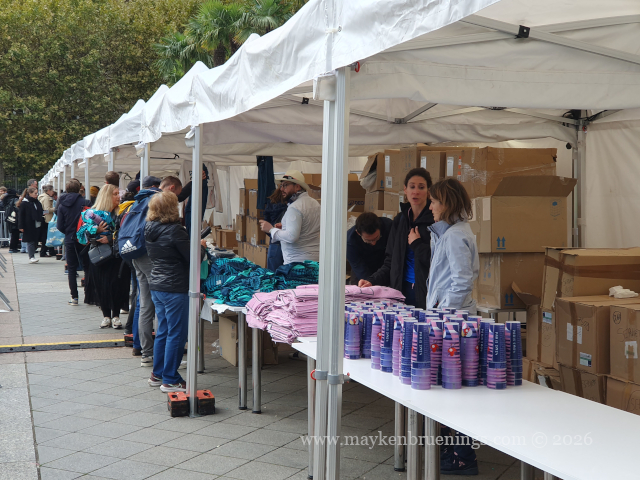
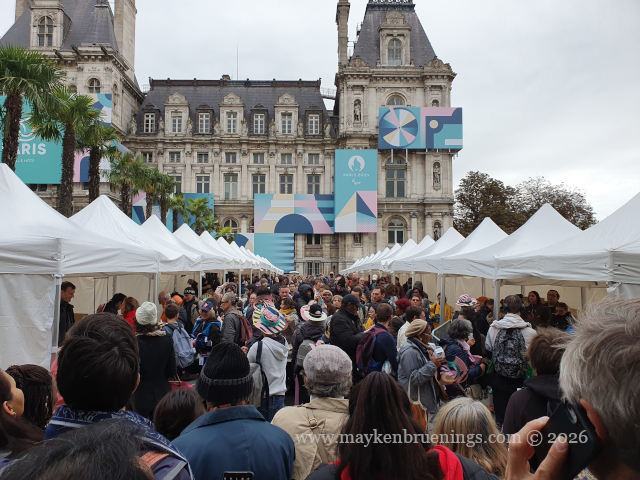
Yes, they are, and that’s why they sell off their remaining stock. Wait, what? Yes, a series of “braderies” in various towns is scheduled between mid-September and mid-October to sell parts of the volunteer or torch relay uniforms, the purple athlete towels, national flags from the various Games sites, drinking cups.
The queue goes all the way around City Hall (this is at the back of the building)
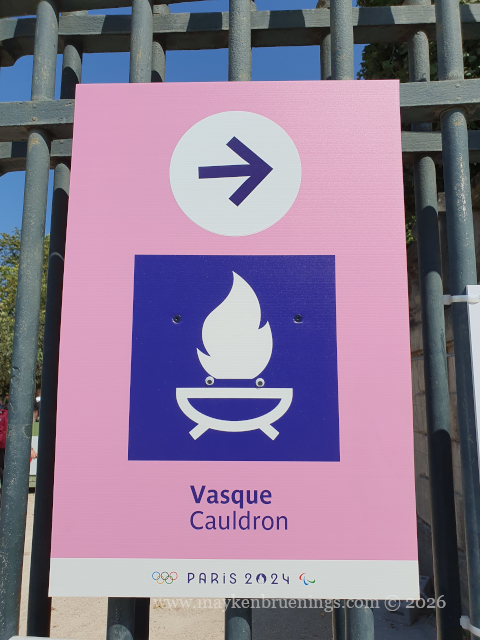
My husband joins the queue at Paris City Hall Square at 7am. When I join him around 11:30, the braderie still hasn’t opened but nearby pink direction signs were distributed for free. An Austrian couple behind us got one; I wonder what they’ll do with it.
By the time we finally get in at 4pm, the ridiculous volunteer hats are sold out, but we get what I’m here for: volunteer socks marked “Paris 2024” but above all, the purple towel. I’ve seen dozens of them handed to the swimmers exiting the pool, to the triathletes crossing the finishing line, to tennis players on the side lines. These are the official Paris 2024 towels! We also get a set of Games cups, some to keep, some to give away.
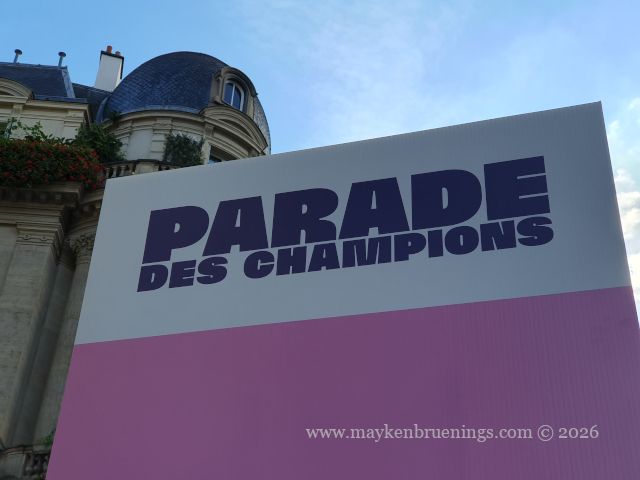
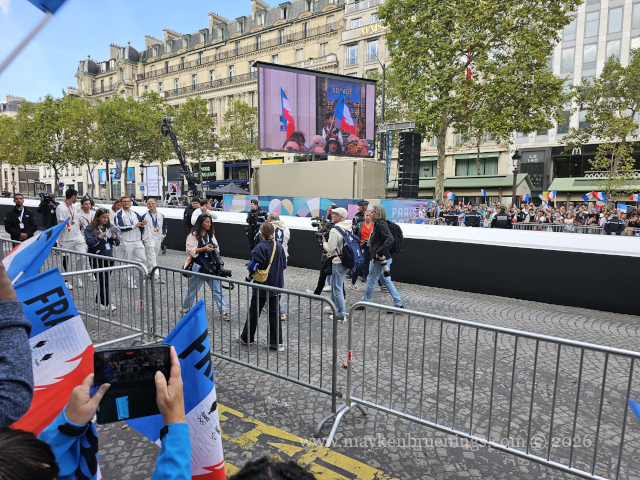
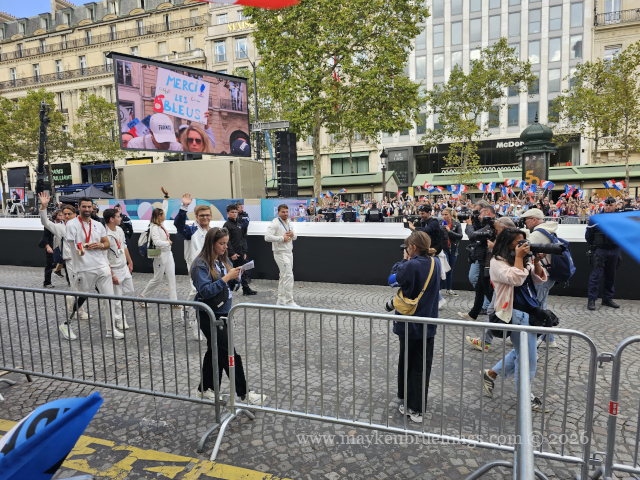
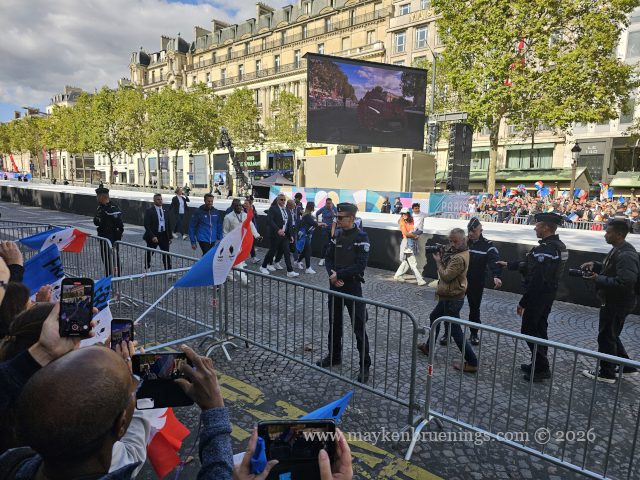
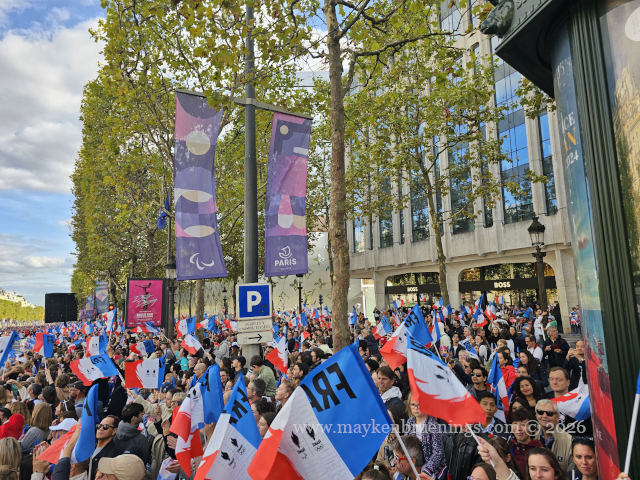
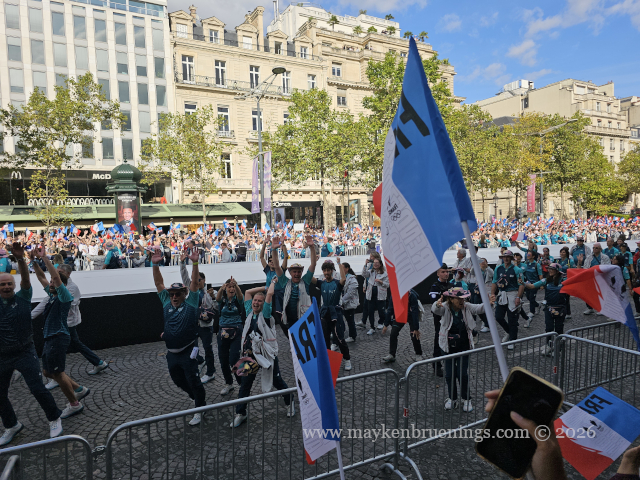
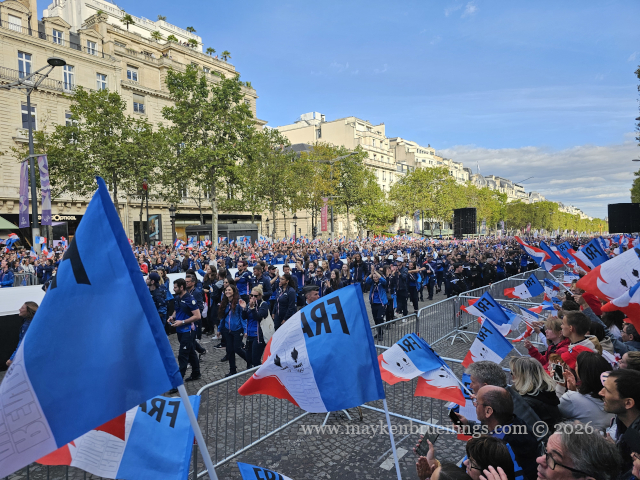
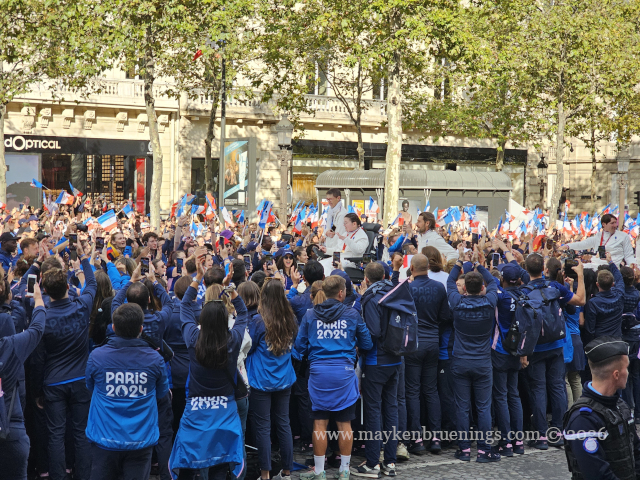
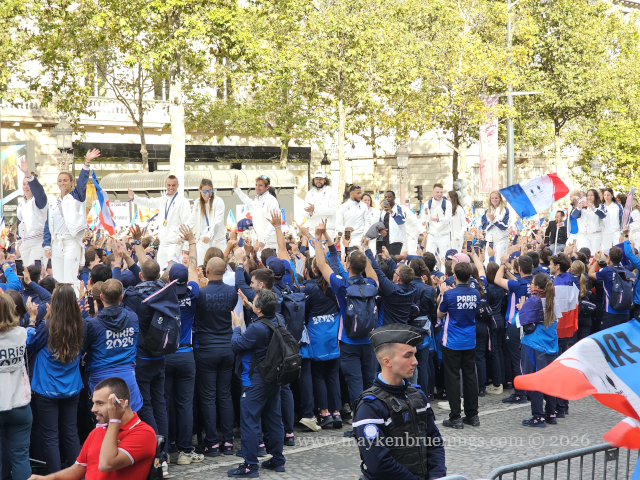
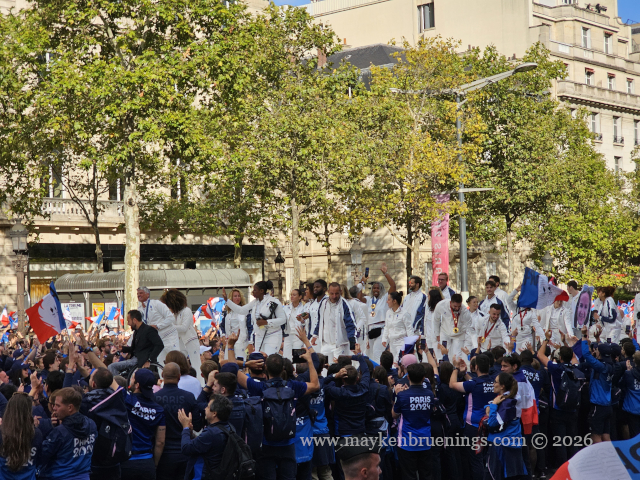
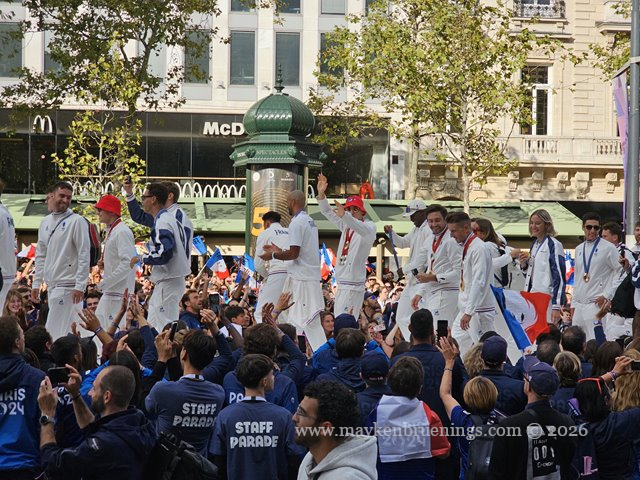
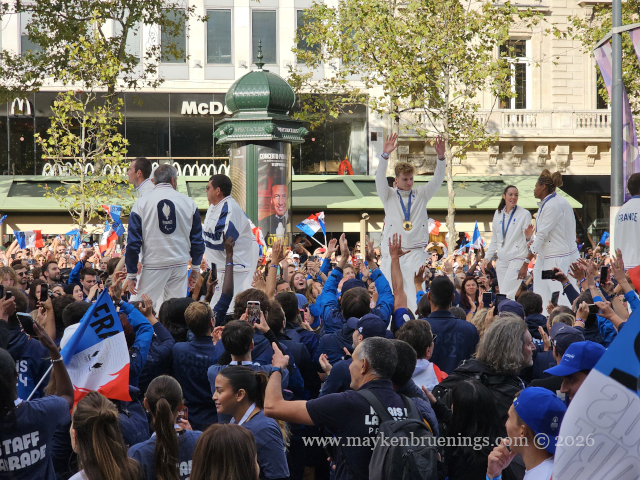
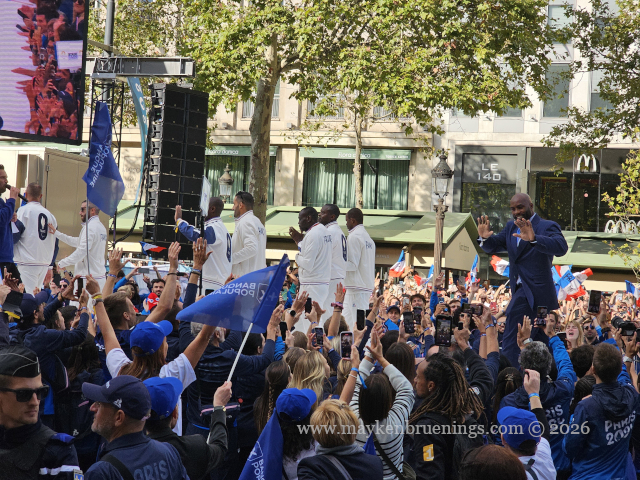
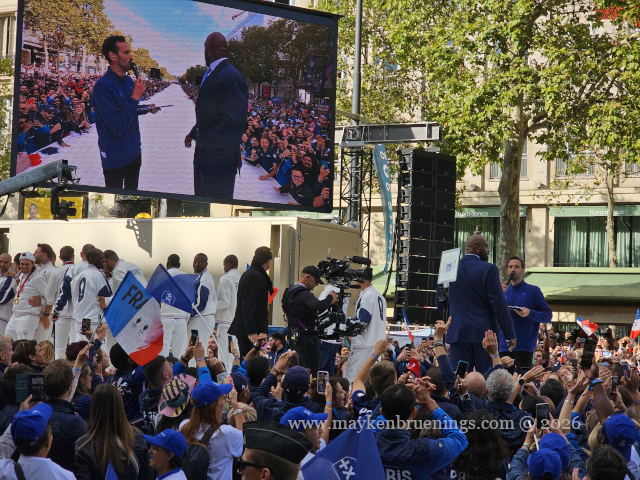
France wouldn’t be France if we didn’t celebrate our athletes with a parade on the Champs Élysées. So of course, we do. And can you believe it? Viewing spots are free! Just sign up quickly enough. We’re pros at quick sign-up by now, and so we have access to a certain sector on the left side (in the shade) of the Avenue. We arrive early, and everyone gets a flag to wave. Yay! We’re in the second or third row, with a very good view, and we made sure to position ourselves with a view of a large screen as well. (Remember the first Opening Ceremony?) On top of that, the athletes are going to walk up on a raised catwalk, so even the people way behind will be able to see them just fine.
The Lebrun brothers, French table tennis stars
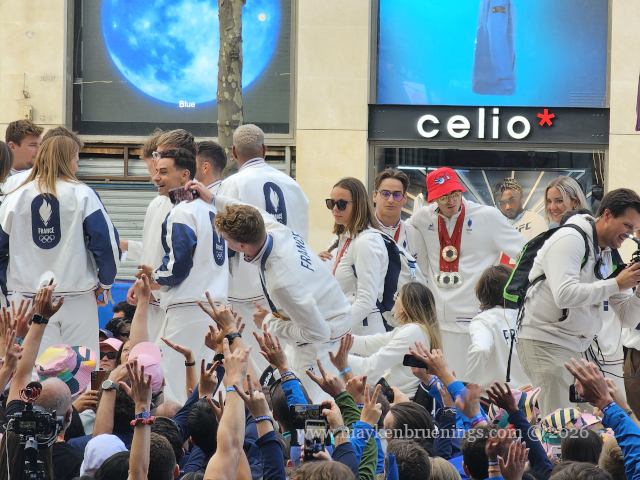
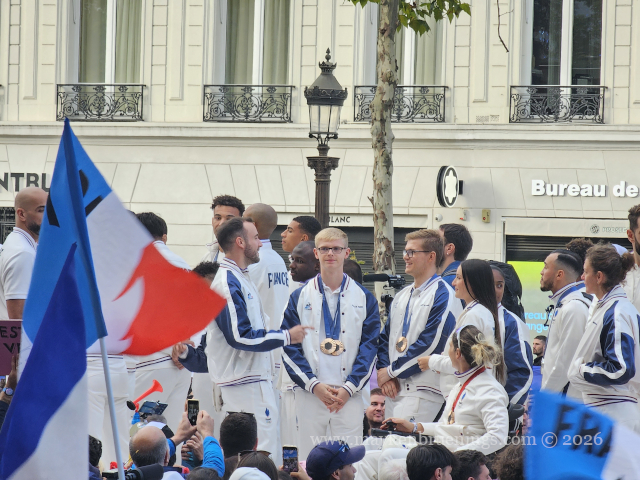
Medalists close up!
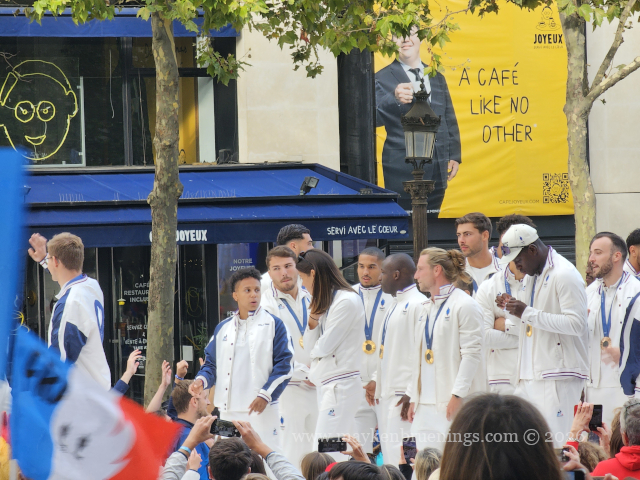
Even before the Parade of the Champions starts, we get a special treat: Several athletes, some with medals around their necks casually walk down the avenue to the starting point, passing right in front of us! And someone else is there, too: Tony Estanguet, the guy who got us the Games in the first place, head of the organizing committee. I shout, “Thank you Tony!” I hope he hears it.
The guy with the blue jacket is Tony Estanguet, head of the organizing committee! Thank you for the party!
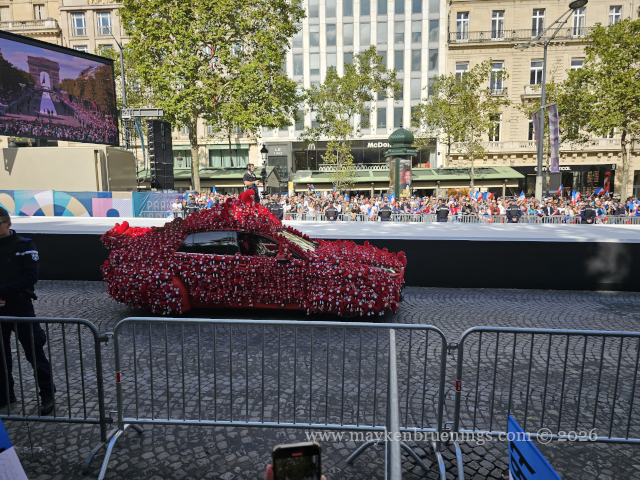
Then we get another treat: The Phryge-covered taxi from the Paralympics Opening Ceremony drives up on one side and back down on the other.
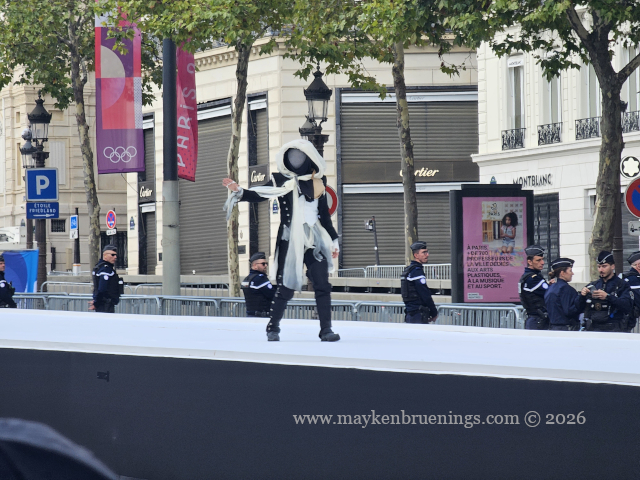
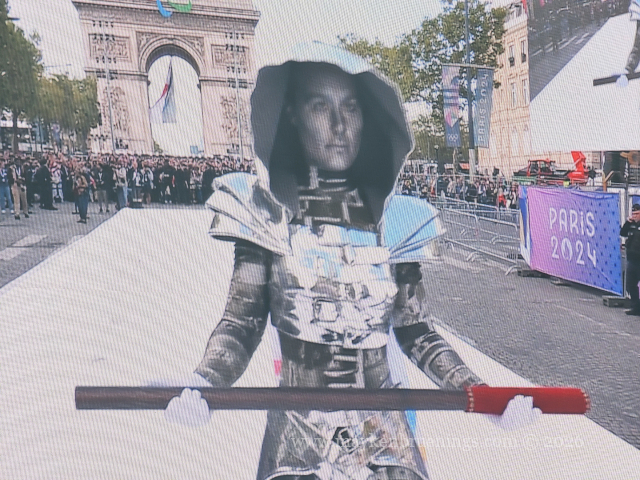
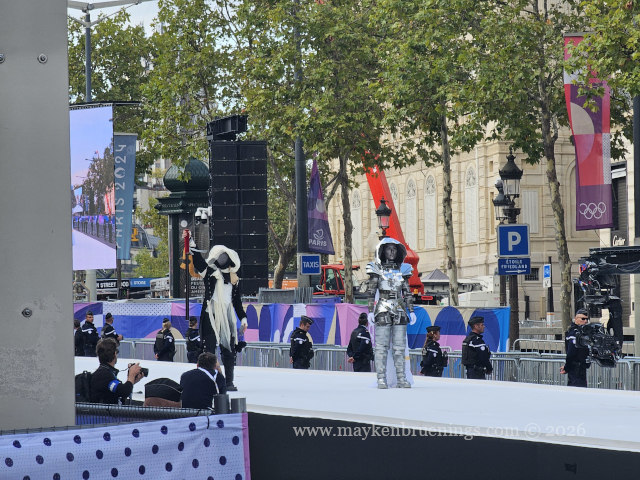
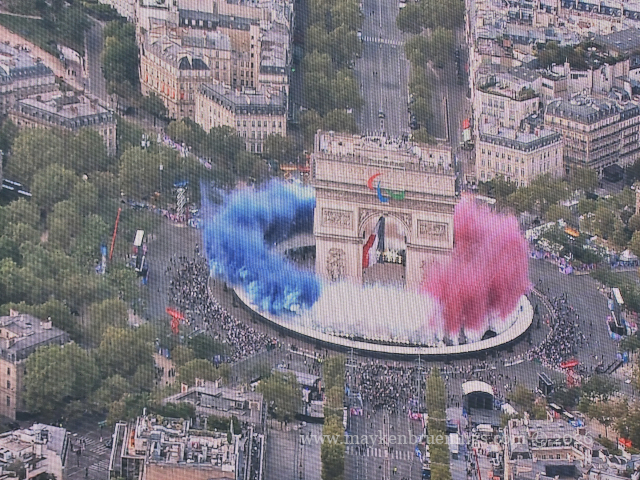
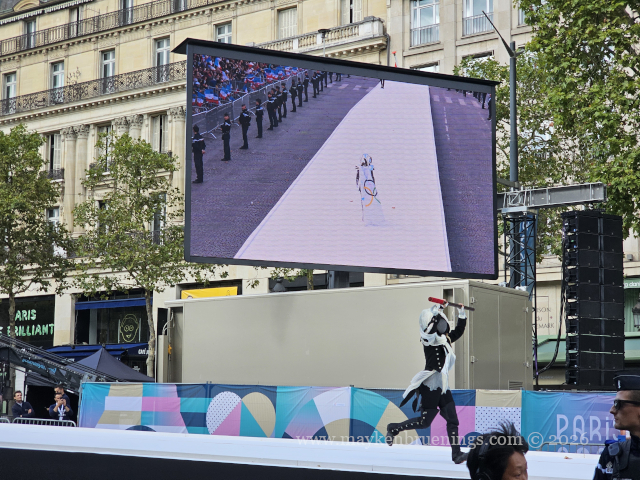
Then the Assassin from Assassin’s Creed who carried the torch over the rooftops in the Olympics Opening Ceremony, walks up the catwalk, only to be met by the mysterious rider of the horse on the river, who hands the assassin a baton. Three “coups de bâton”, the French national colours explode around the Arc de Triomphe, echoing Austerlitz Bridge at the Opening Ceremony, and we’re off.
The Assassin’s Creed assassin
The mysterious rider from the Olympics Opening Ceremony with a “bâton” (on the screen)
Rider and Assassin right in front of us!
The Arc de Triomphe as we saw it on the big screen
The Assassin on screen and live right in front of us
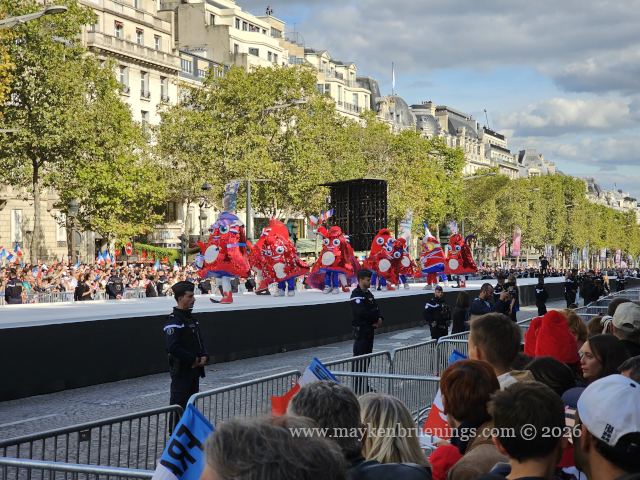
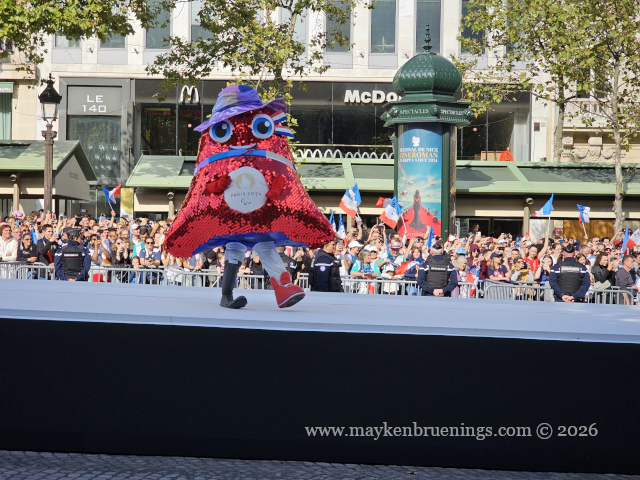
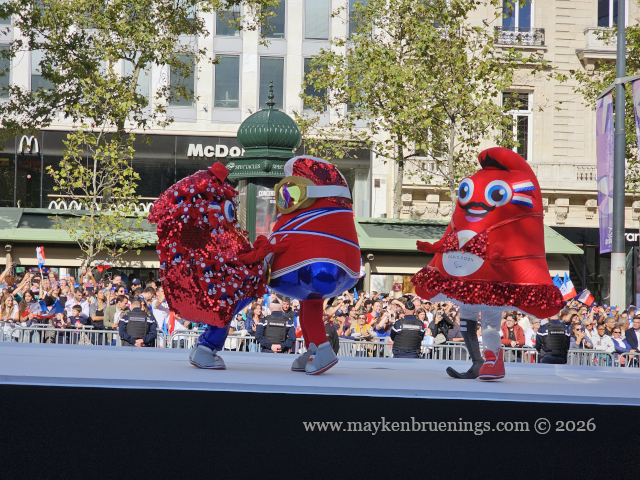
The Parade is led by a bunch of life-sized Phryges. They are so adorable! There’s one covered in sequins, one is Léon Marchand with his swim goggles and medals, one wears the now famous but still ugly volunteer uniform hat.
Parade of the Phryges
The volunteer Phryge (the volunteer uniform hat was in high demand)
The Léon Marchand Phryge
That’s all the people behind us!
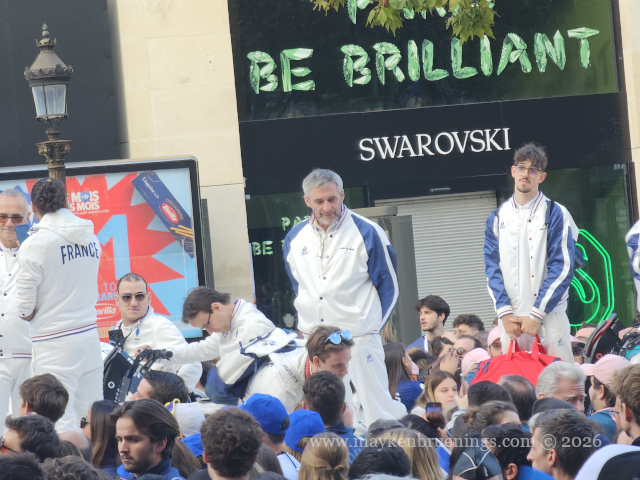
Games volunteers and members of Team France take their well-deserved viewing spots between the catwalk and the barriers.
And then, finally, the athletes.
Paralympic boccia champion Aurélie Aubert with her coach Claudine Lliop
The Portal brothers (we saw them at the paraswimming event) with the red hats
Léon Marchand with one of his four (!) gold medals
Teddy Riner in his best suit
Teddy Riner on the big screen and right in front of us
Center left with beard: Antoine Dupont, captain of the gold-medalling French rugby team
My favourites: Léon Marchand letting a blind para-athlete hold and feel one of his medals (Olympic medals are slightly different from Paralympic ones and obviously have no Braille), and Teddy Riner, the French star judoka, wearing a nice suit. Why? Because once they are at the top of the Champs Elysées, the medalled athletes get Decorations (Legion of Honour or National Order of Merit) but as he has already received several and so gets a higher level one, he has to be dressed up. The Decorations are presented by a number of high-profile athletes (and the new Prime Minister). President Macron cherry-picks the likes of Léon Marchand and Aurélie Aubert.
One of the Portal brothers (red hat) – we saw him win one of those medals!
The Lebrun brothers (with glasses) – table tennis champions
Stéphane Houdet, the wheelchair tennisman we saw play at Roland Garros stadium!
For the Decoration part, we’re already back home and watch it on TV (front-row seats!). The athletes party into the night.
That was our last live participation. But the Games were still not over.
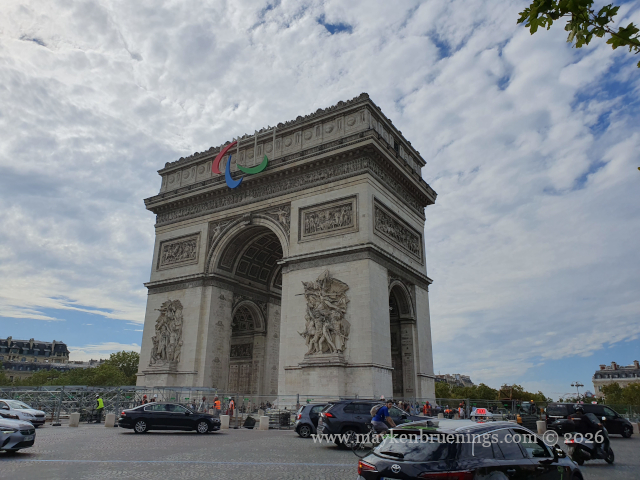
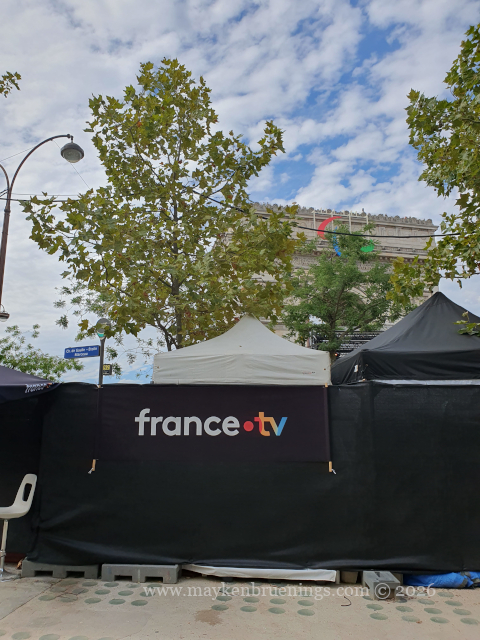
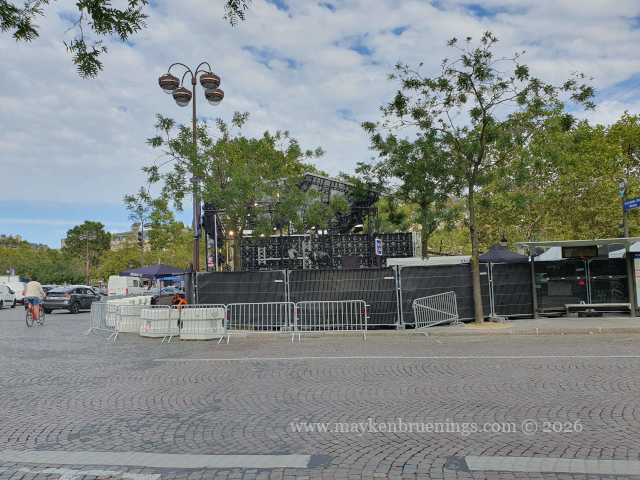
For the Paralympics, the public French TV had set up their stage opposite the Arc de Triomphe which sported the Agios, the Paralympics symbol. Of course I had to go and check it out.
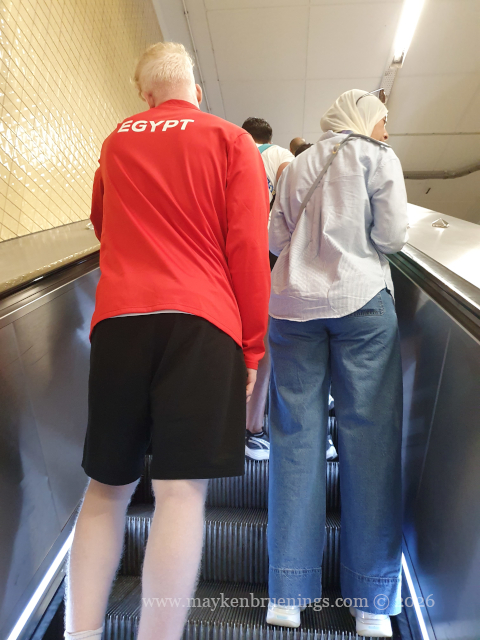
I met an Egyptian on the metro!
Then finally, the Closing Ceremony officially ended the Games. Or did it?
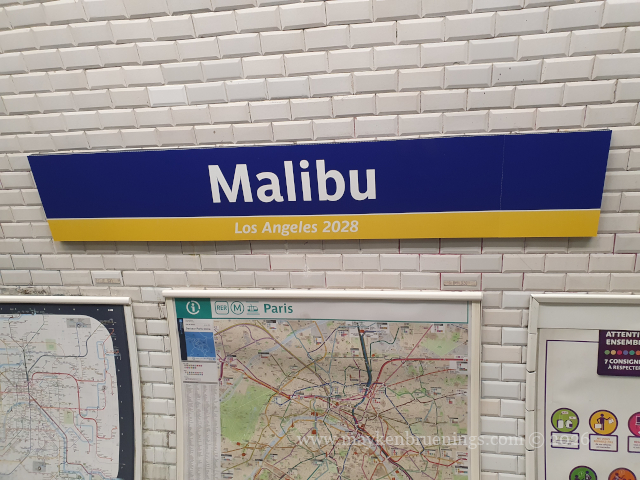
No! Partnering with Los Angeles public transport, the Paris transport company renamed six stations for a few days, as did Los Angeles. “Downtown Santa Monica” became “Saint Germain des Prés”, and “Saint Michel” was “Santa Monica”. One of my stations, “Malesherbes”, suddenly was “Malibu”.
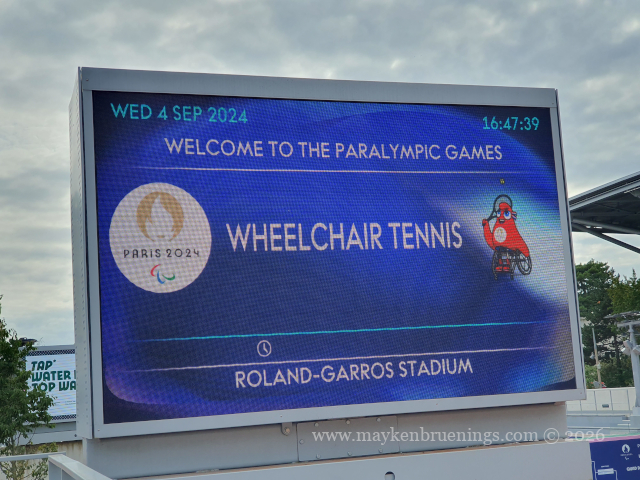
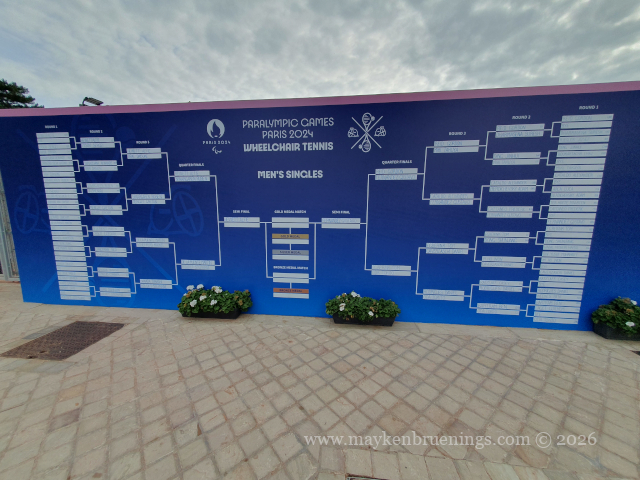
School has started again; we’re at the beginning of September. But my husband enjoyed the Paraswimming so much, we go on the official ticket site and snap up two wheelchair tennis tickets for Wednesday afternoon. I love everything about the Games, and my husband is thrilled to get into the famous Roland Garros tennis grounds, which are inaccessible to ordinary folks during the Grand Slam tournament, the French Open.
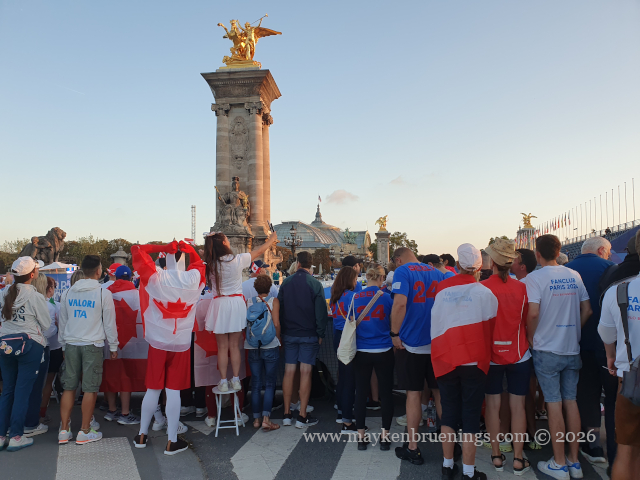
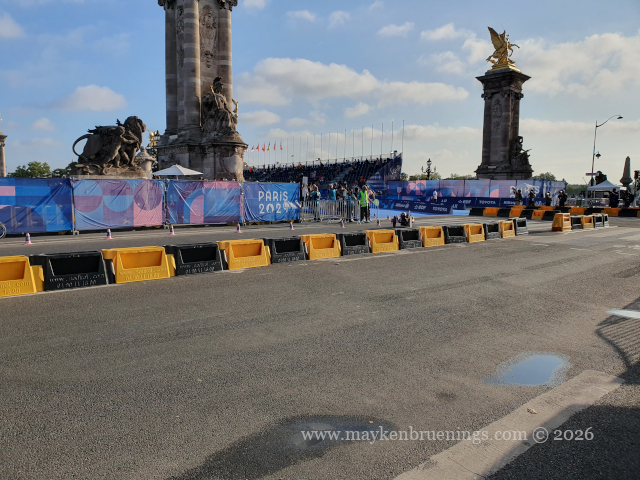
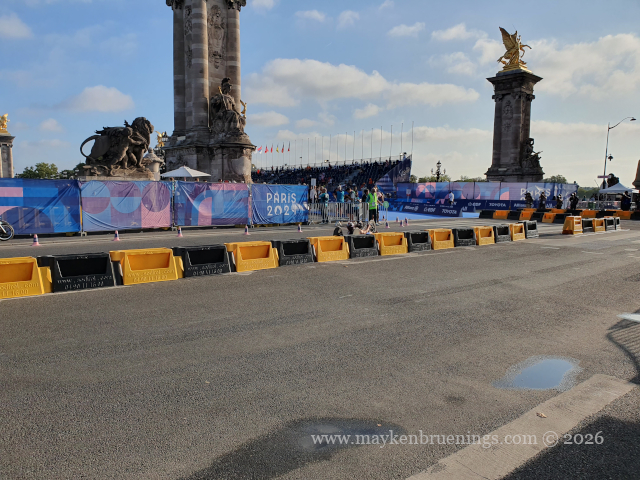
But even before we head out to the Bois de Boulogne for the tennis, I set my alarm early again and on the way to work stop at Invalides for the Paratriathlon. Once again, the first event has to be postponed. Instead of Sunday morning, it is now held on Monday after the events scheduled for Monday.
As I arrive, I understand this time the river view is not accessible. So I make sure I get a good spot to see the cyclists. Lots of other people around me despite the fact that the summer holidays are over, and most Games tourists have gone home. The wheelchair triathletes are up first, and there’s a French athlete competing, I hear. When they zip past, we collectively scream our lungs out. What a way to start your day!
Tennis time!
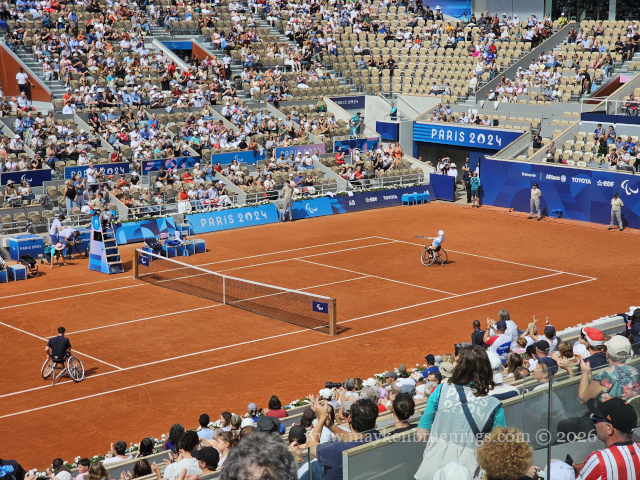
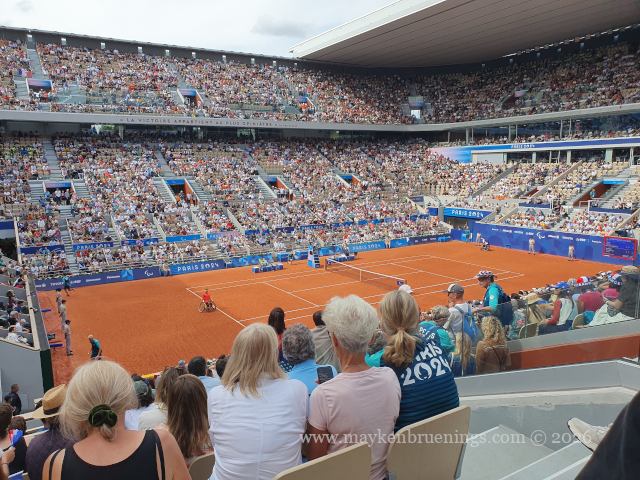
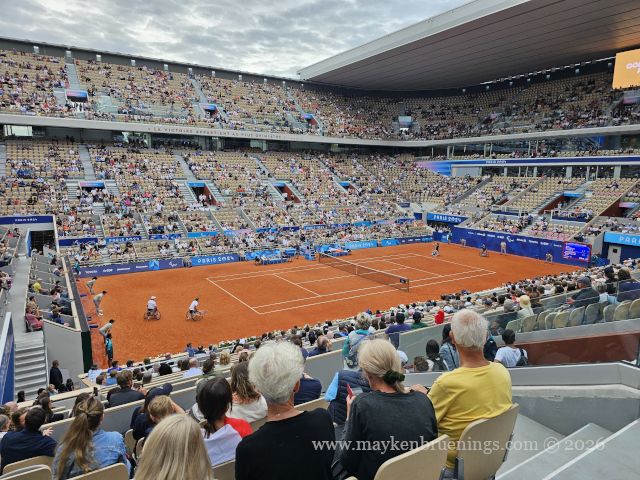
We’re early at Roland Garros because we want to check out the whole site. There are two main courts for which you need specific tickets, Suzanne Lenglen, and Philippe Chatrier, for which our tickets are good.
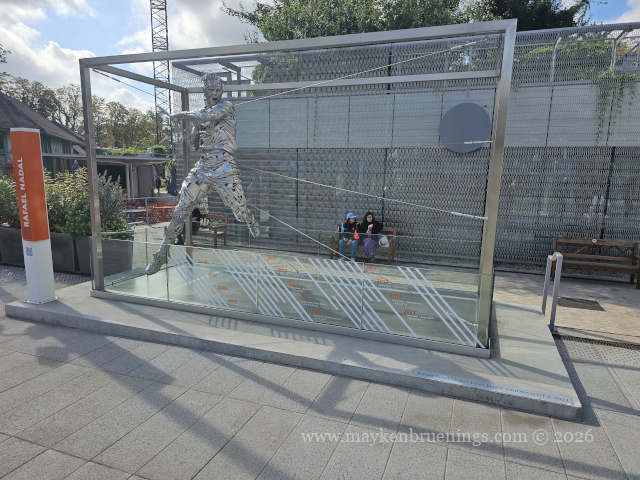
There is a statue of Raphael Nadal who won the French Open more often than I can count, and the famous tennis Musketeers from way back when.
Rafael Nadal
We have great seats (that weren’t all that expensive), and of course we wear our new Games T-shirts.
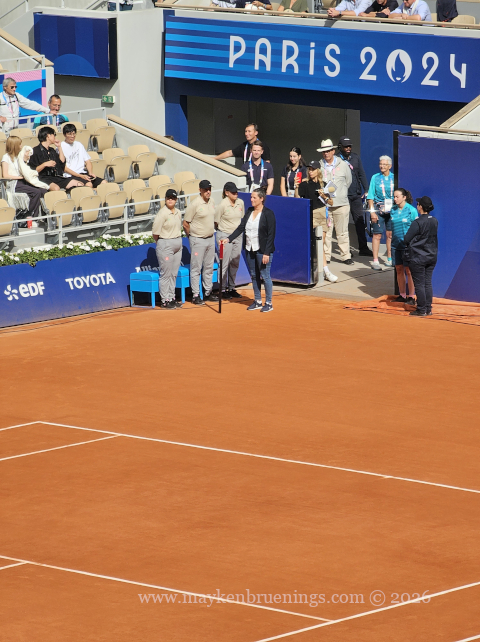
The 3 “coups de bâton” open the session
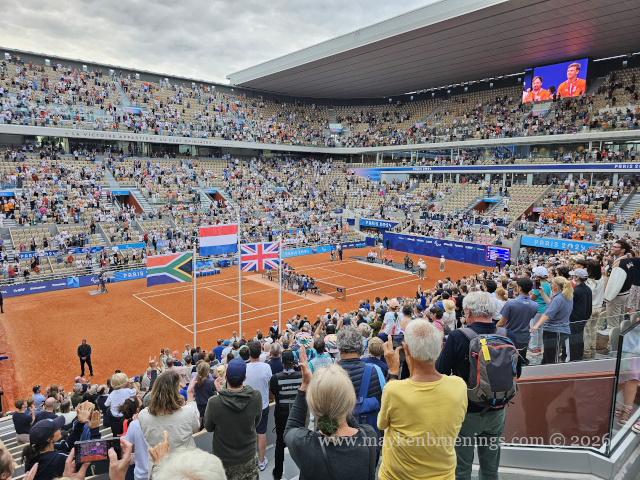
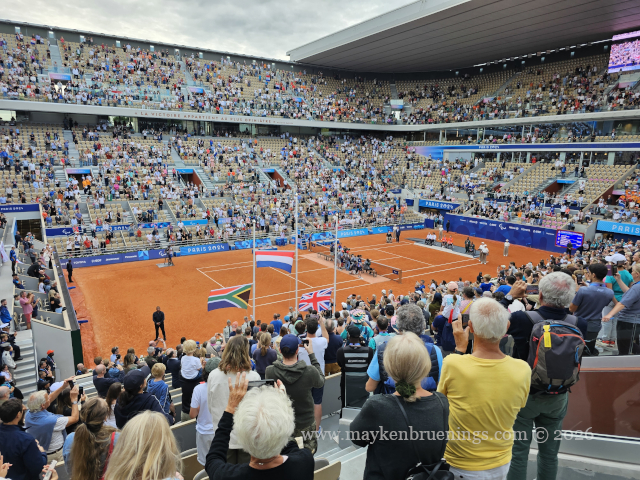
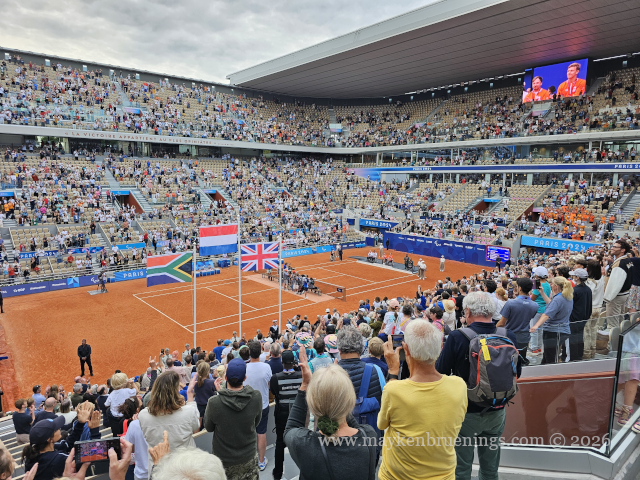
The session starts with the three “coups de bâton”, and off we are for the first match, a quarter final opposing a Scot with his own tiny but very loud fan club, and an Argentine.
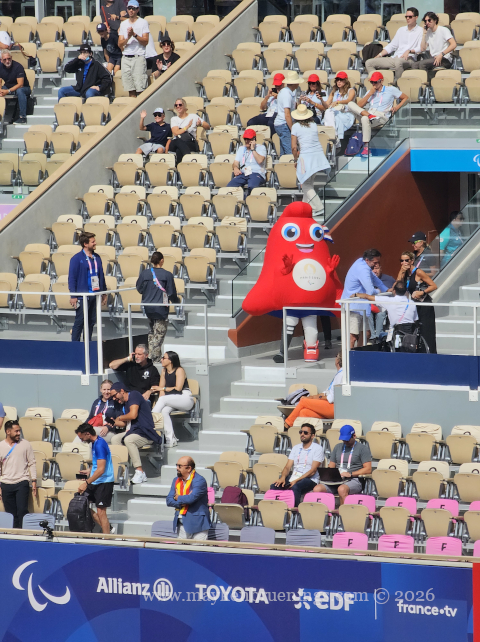
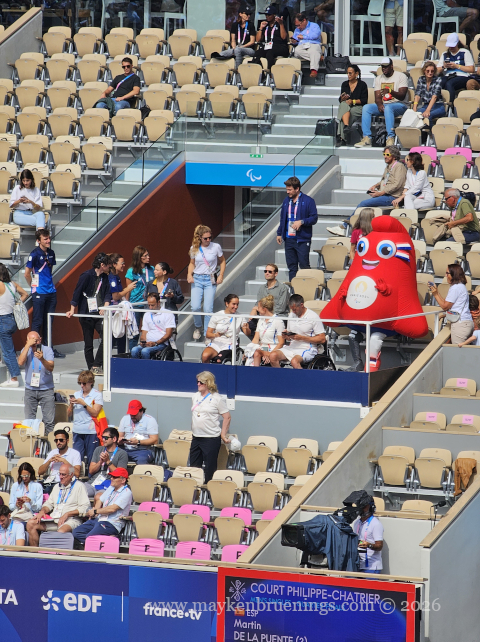
The French fan corner fills up and Phryge the mascot arrives in the stands when a French player is scheduled for the next match, against a Spaniard.
Since it is Wednesday afternoon, when Paris kids don’t have school, there are several day camp groups. And once the kids understand how to launch audience cheers, the atmosphere heats up. However, this is still tennis, so the obligatory “Quiet, please” resounds again and again.
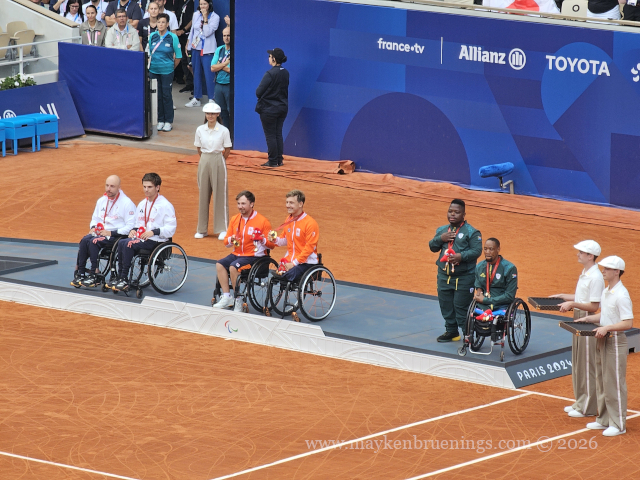
The final match of the day on our court is a doubles final, opposing Dutch and British players, so we get a medal ceremony at the end.
The Paralympics Opening Ceremony was held on the Place de la Concorde. While the athletes marched in, a group of life-sized Phryges played games (think catch and red light, green light) at the center of the square. We only saw that later in phone videos made by spectators, as the TV cameras were focused on the athletes.
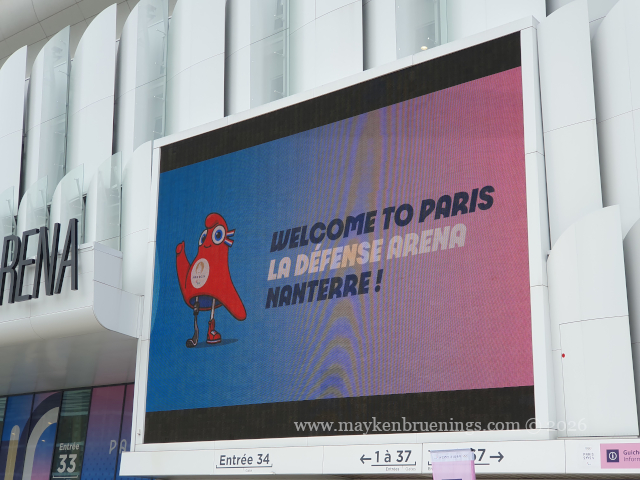
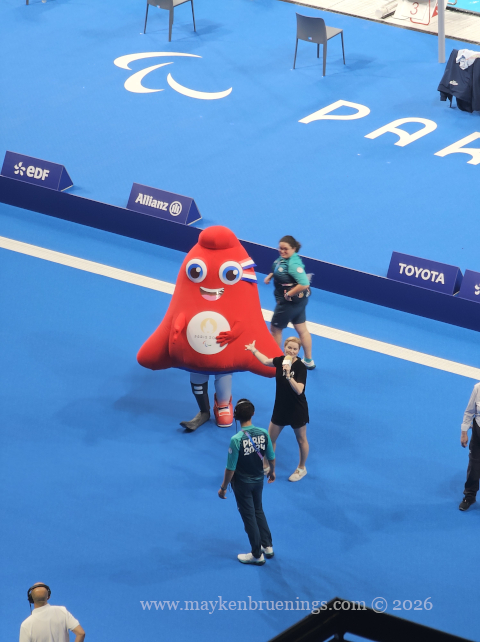
La Phryge at Paris La Défense Arena
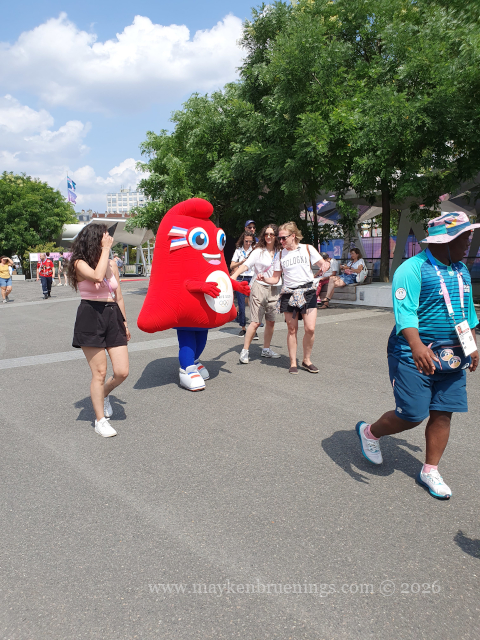
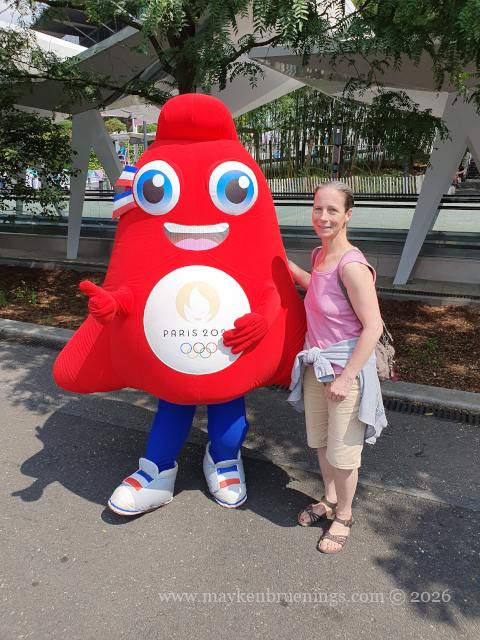
If we could love our Phryges any more than we already did, we would!
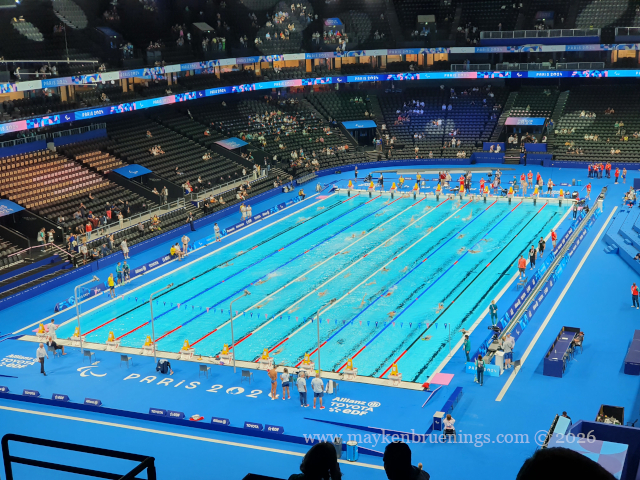
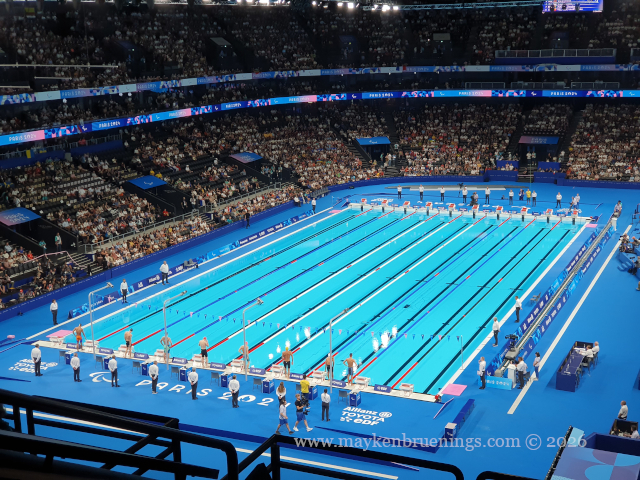
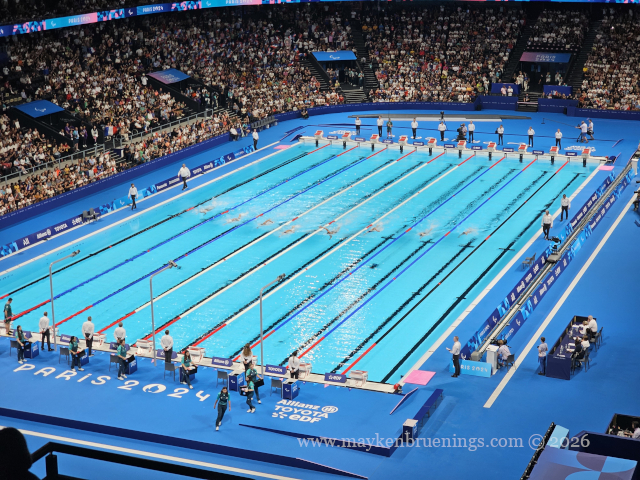
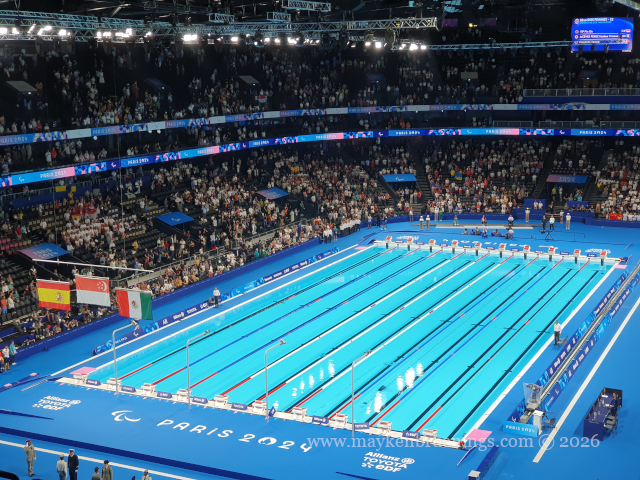
Finally, the day I’ve waited for since October is here: our Paraswimming session is on. Like most Games sites, the pool is temporary; the Paris La Défense Arena usually holds concerts and rugby matches. The three pools set up for the Games are already marked to go somewhere else. I think one of them will be reassembled in Toulouse later.
Warm-up at the Paralympics is just as chaotic as it is at my meets.
My choice of session proves lucky: We have a race with two French brothers, and another with Brazilian star Gabrielzinho. The warm-up doesn’t look so different from warm-ups at my own swim meets.
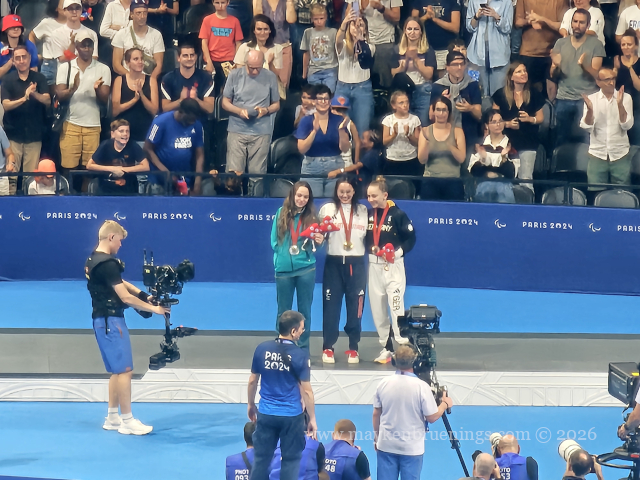
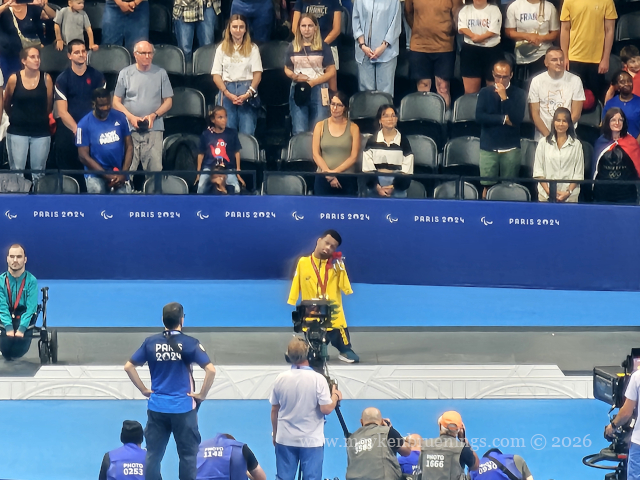
The three “coups de baton” open the session. We have a really good view of the pool. It’s all finals, and medal ceremonies are held in between races. One of the details you don’t see on TV: we see a camera man with a camera on his shoulder who keeps having to run the length of the 50m pool to film the swimmers as they arrive to the medal ceremonies held at the other end. At one point he sits down and massages his shoulder.
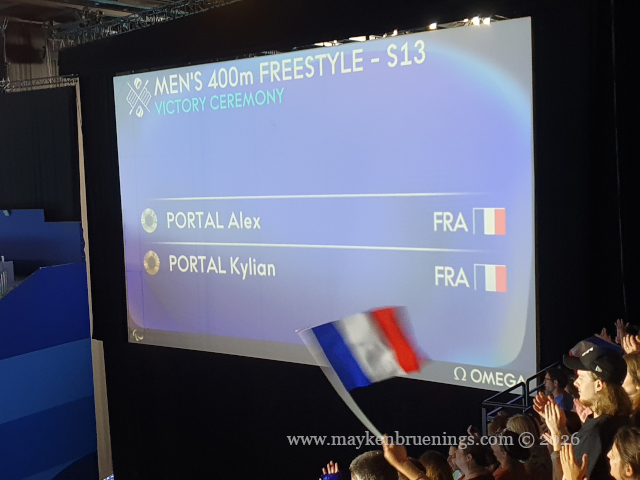
When the French Portal brothers arrive for their 400m freestyle race, the audience goes nuts. 400m is a mid-distance event, but it’s the longest race of this session. The atmosphere is incredible; we shout ourselves hoarse. Successfully, as Alex and Kylian win the silver and bronze medals. During their medal ceremony, the noise level reaches a new height.
Brazilian paraswim star Gabrielzinho
Gabrielzinho totally steals the show at his race, where he wins gold.
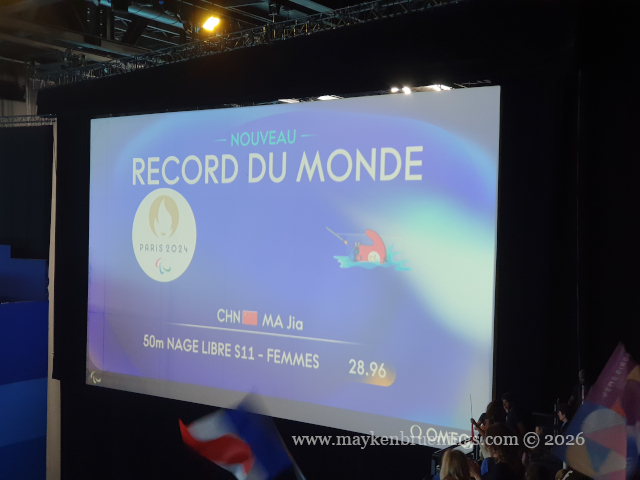
We saw a world record!
Being in the room where it happens is such an incredible experience!
A medal ceremony (flags being raised on one end, the podium on the other).
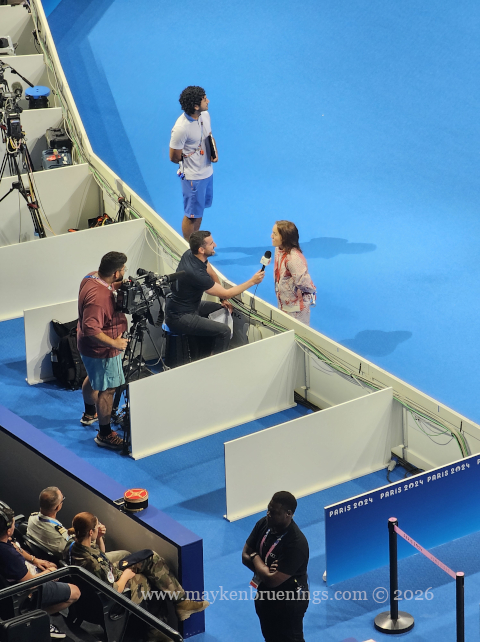
Canadian paraswimmer Tess Routliffe is interviewed by Canadian media after her silver medal in the 200 medley
We came home from holidays and went back to work. The Olympics were over, but the Games were not. Métro billboards showed athletes alongside the slogan “Games not over”. And they weren’t. The Paralympics were yet to come.
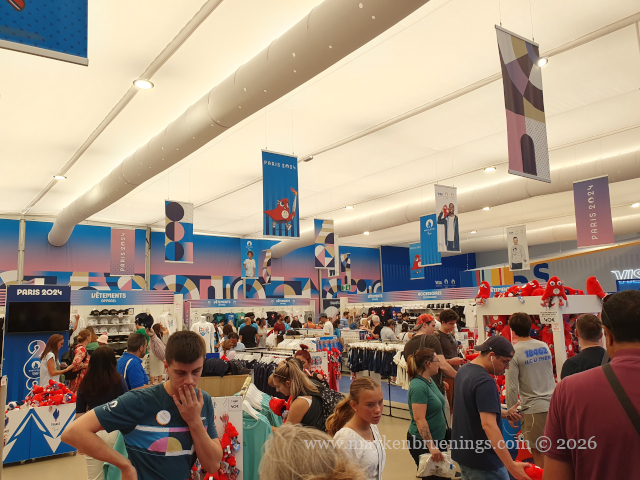
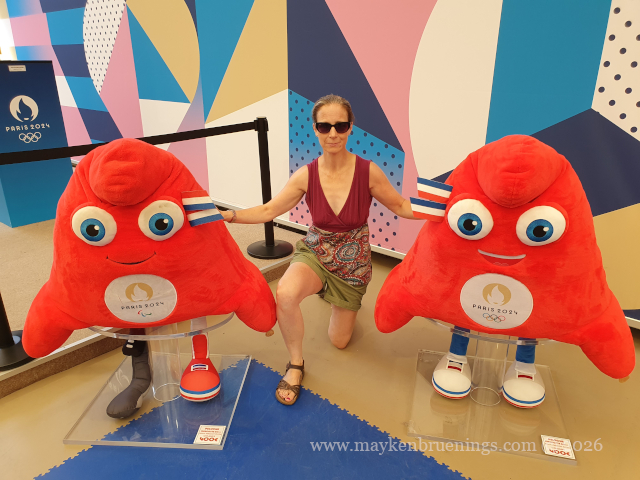
Olympics items were already on sale at the official Paris Games store
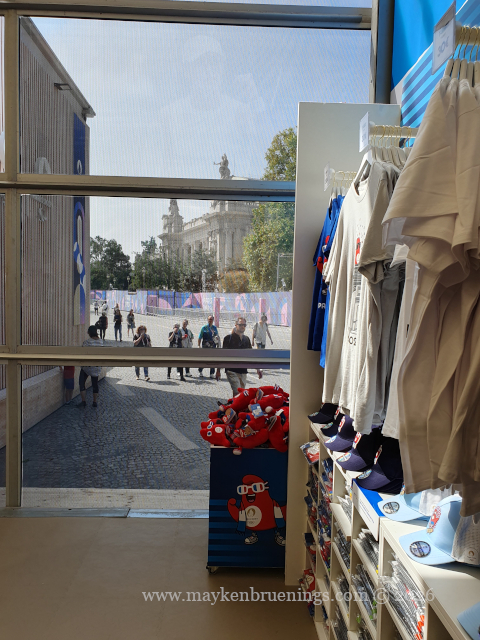
While the sites and the athletes’ village were adapted, we took advantage of the lull in visitors and stopped by the official store on the Champs Élysées, scoring limited edition shirts and, of course, the mascot.
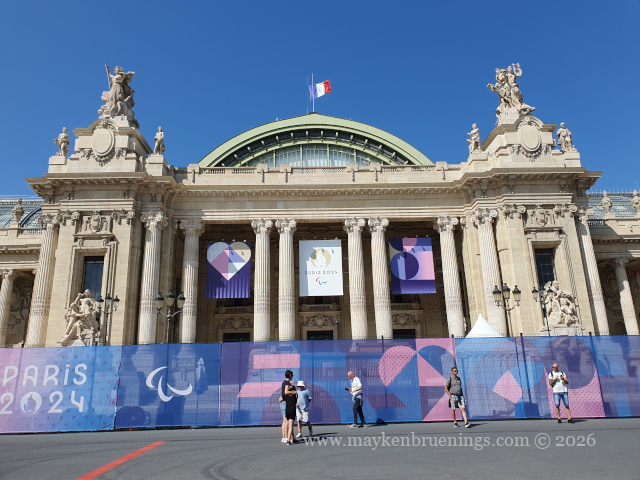
The Grand Palais seen from the official Paris Games store on the Champs Élysées
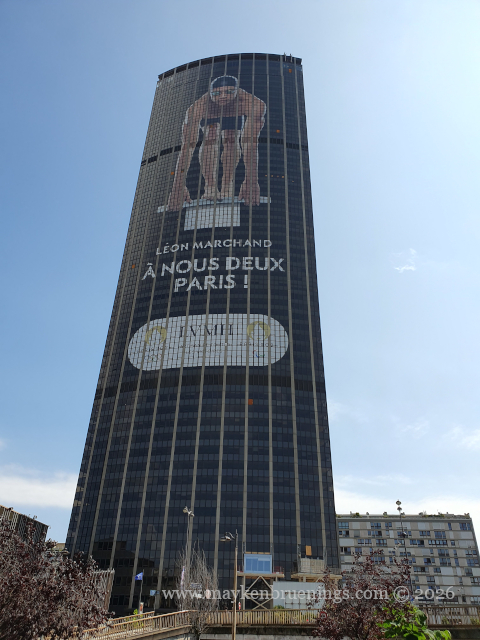
The very ugly lone skyscraper in Paris, the Montparnasse Tower, was decorated with the effigy of Léon Marchand, France’s Olympic hero.
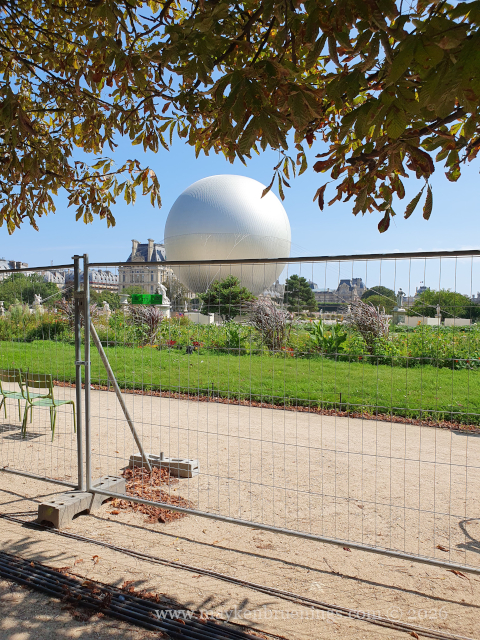
The Cauldron was still in the Tuileries, the flame extinguished, awaiting the second Opening Ceremony.
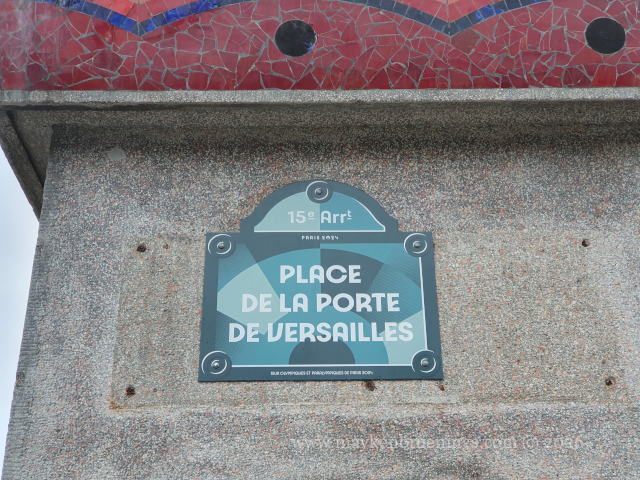
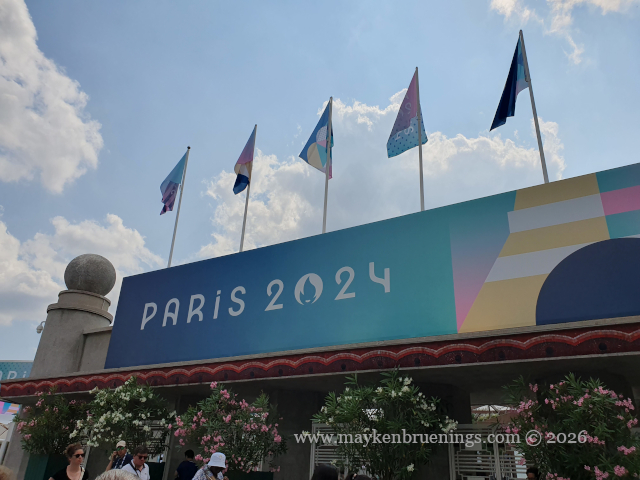
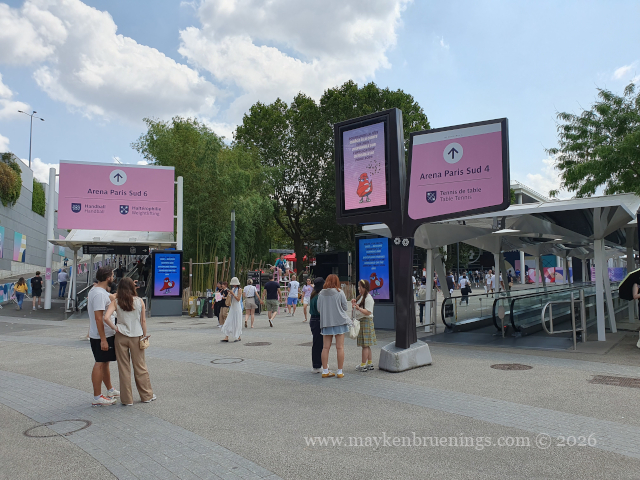
Paris Porte de Versailles fairgrounds were rebranded as Arena Paris Sud
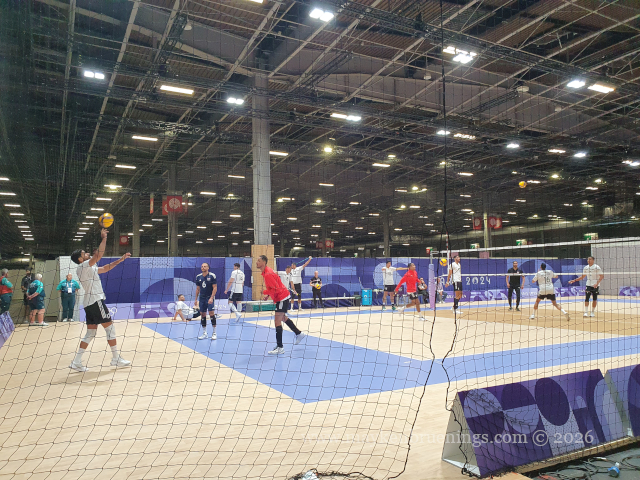
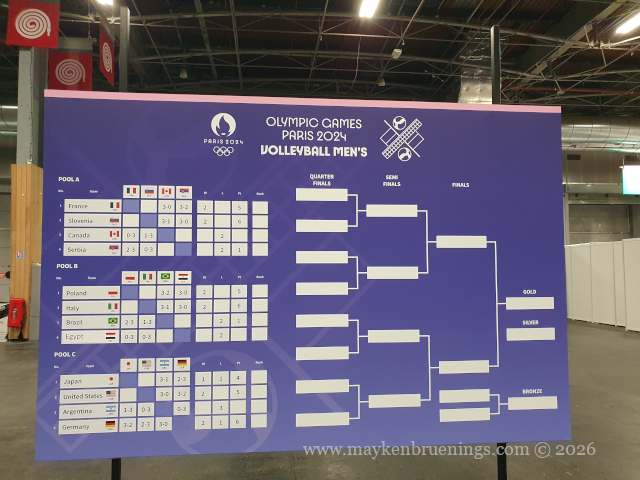
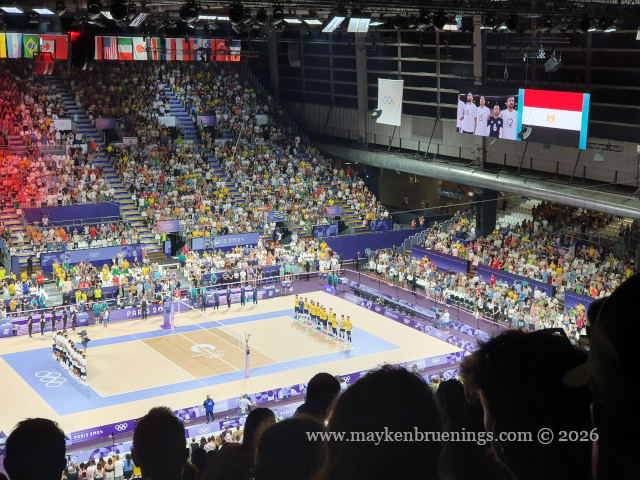
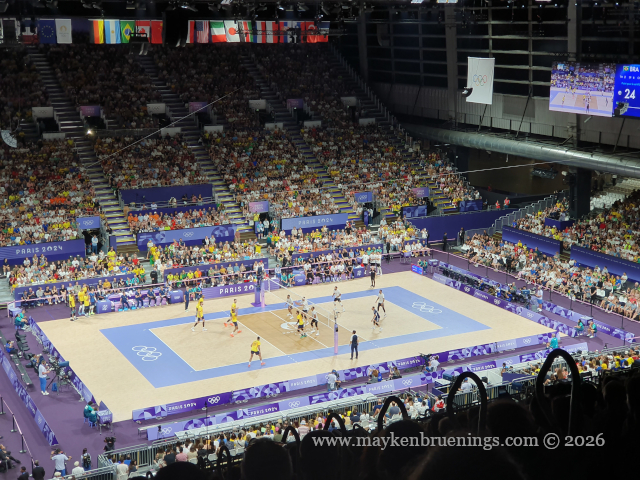
Friday came along, and I was far too early at Arena Paris Sud. The tram stop in front of the site was closed and you had to get off either at the one before or the one after, but again, pink signs and friendly volunteers were everywhere. Arena Paris Sud is the Paris fairgrounds, which I’m very familiar with due to it hosting the International Agricultural Fair every February. For Paris 2024, it hosted table tennis (featuring the French brothers Alexis and Félix Lebrun), handball, weightlifting, and volleyball. As I arrived, a big crowd of spectators left the grounds, apparently a handball match had just ended.
Left for handball and weightlifting, right for table tennis. (Volleyball is behind you.)
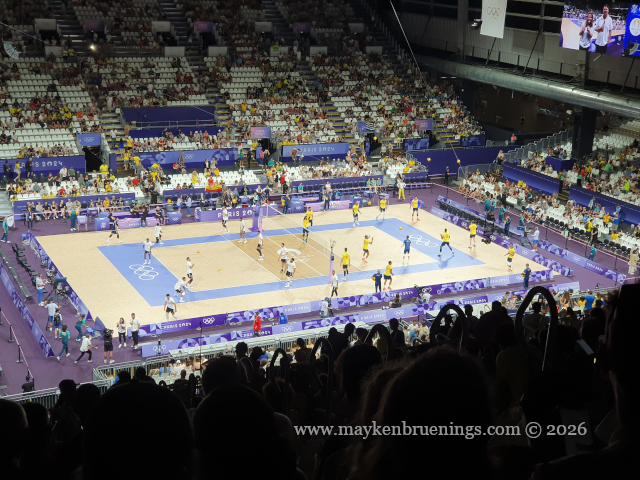
There were strict controls, not only of tickets but also of bottles. You had to take a sip from your bottle if it was full, but you could bring an empty one like I did and fill it up on the premises. Once inside, there was volleyball-themed entertainment for the visitors, and you could watch the two teams warm up. In my case, it was the favored Brazilian team against the outsiders from Egypt in a pool game that wasn’t shown on any of the French tv channels.
The Egyptian team warming up in Hall 1
Once we were seated, pre-game animations included an overview of the rules, and cues for us to encourage the players.
Warm-up in the arena
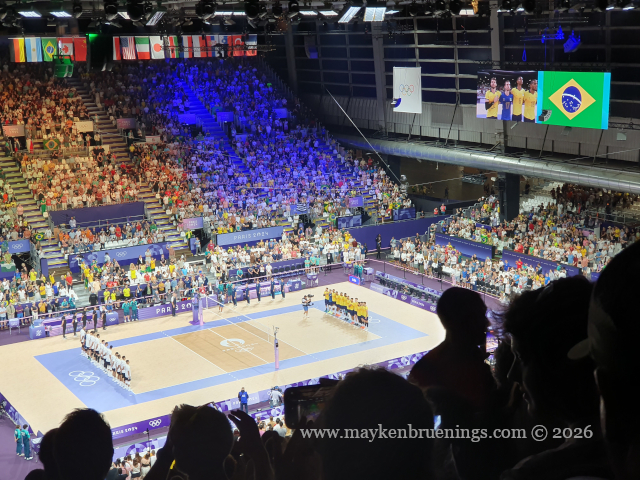
There was music too (“Walk like an Egyptian”), and during the national anthems, Brazilians outnumbered Egyptians among the spectators.
Even more important, there were the “trois coups de bâton”. This is a tradition from French theater, thumbing a staff three times on the floor to open the session. In more prestigious sessions, notables, celebrities, retired athletes, would give the signal. In my pool match, a volunteer did the honors. It still felt special. I was part of the experience, of the Olympic Games.
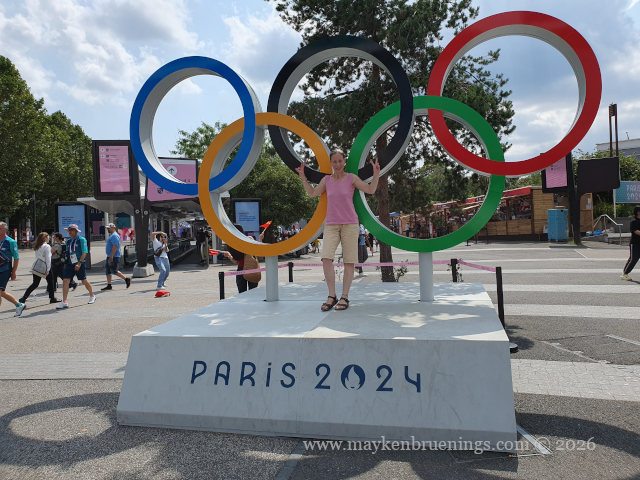
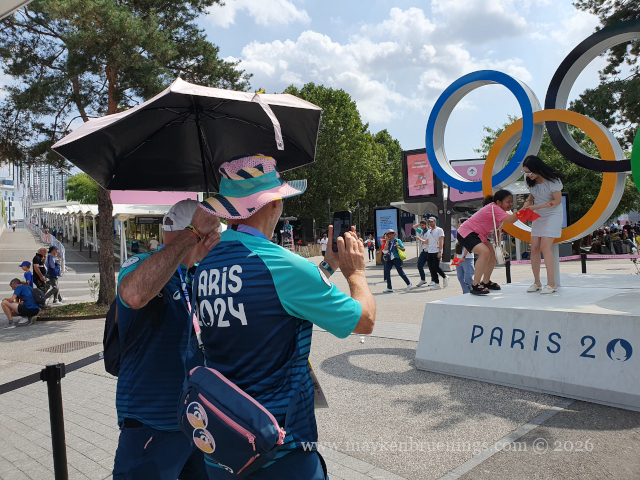
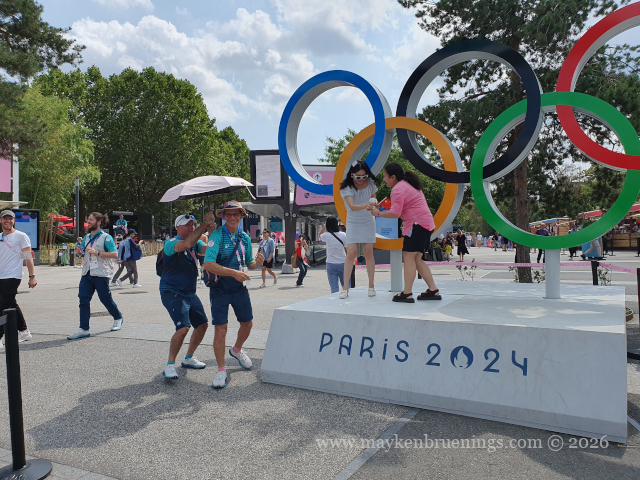
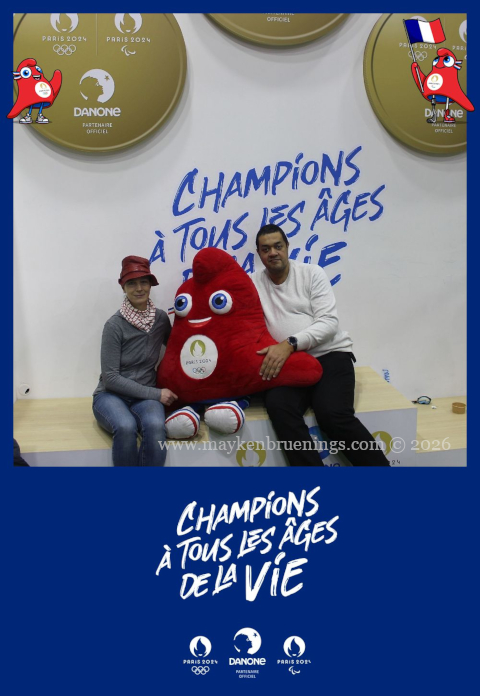
Unfortunately, the match was over quickly, the Brazilians beat the Egyptians 3:0 in 75 minutes. But my Olympic adventure wasn’t over yet. On the common premises of Arena Paris Sud, not accessible before the match, you could buy souvenirs at the official licensed shop and get your photo taken with the Olympic rings. You joined the line, and when it was your turn, a friendly volunteer would take your phone to snap a dozen pictures. Everyone waited patiently while you installed your kids, no one grumbled.
I’m at the Olympics!
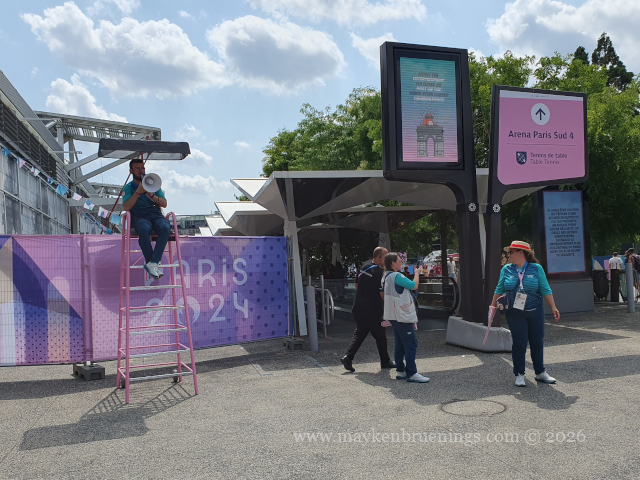
Another volunteer sat in an umpire seat (think of a tennis match) and directed traffic, aka the various spectators ambling around after their sessions.
So much love for the volunteers! That guy in the umpire chair made some fun announcements.
Two ladies were in the line ahead of me, one carrying an umbrella to protect her from the sun. While volunteer 1 took the phones and the ladies went to pose with the rings, volunteer 2 held the umbrella over his colleague’s head.
As we left town for our summer vacation, the second week of the Olympics happened on tv for me. I missed out on cheering the athletes at the Olympic marathon, or the people at the “marathon for all” that followed it; I didn’t see the road cycle race. What I did was stay glued to the screen when Léon Marchand, whose name I’d not heard before, swam to quadruple individual gold, winning two of those in a single day, and topping it off with a team bronze in the relay. How much I wish I’d been able to get tickets for Olympic swimming!
Remember the expensive tickets? Finally, some promised cheap tickets showed up. Granted, it was on the official ticket exchange where you could resell your strictly personal ticket. With the Games already in full swing, I scored a 24 € ticket for a volleyball match on Friday morning. (I wanted a sport I know at least the basic rules off, and swimming was still very much out of reach.)
And there were also the street events. That’s what they called everything happening out in the open: road cycling, marathon, triathlon. Given the high security zones mentioned earlier, you’d think watching something for free would be impossible. Well, it wasn’t.
Alexandre III Bridge where the triathlon is about to start (Grand Palais in the background)
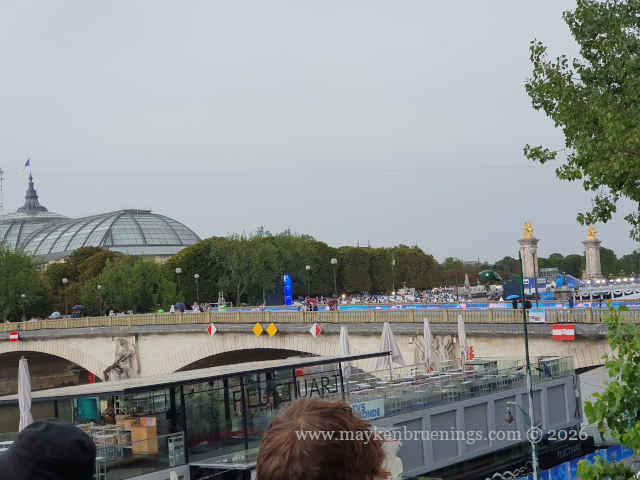
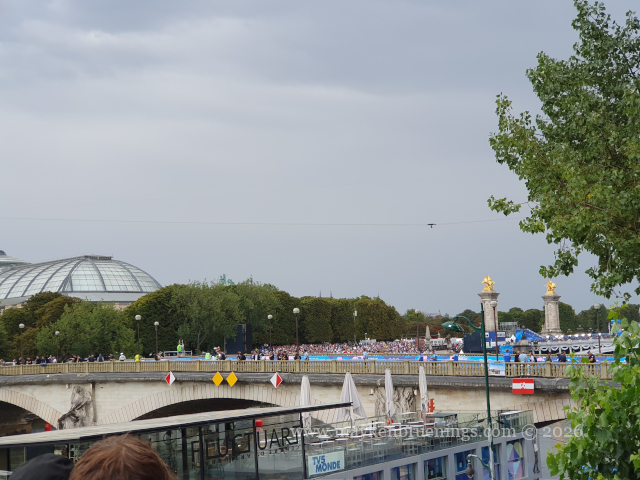
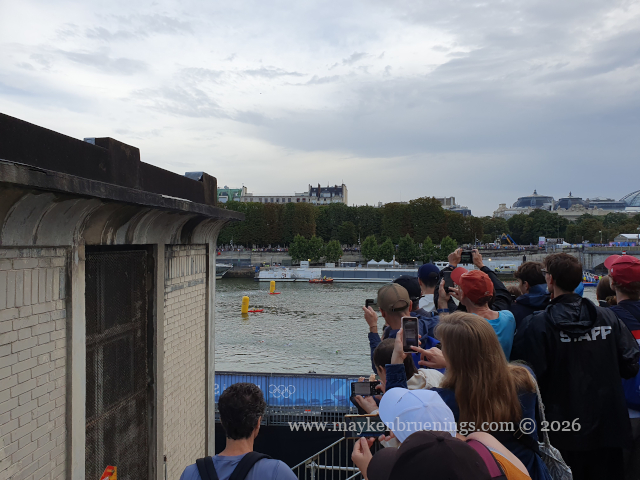
When I went to see the triathlon, the only problem was the (much maligned) water safety issue. The first day’s races had to be postponed, and even on the second day, it was still raining in the morning. The Pont Alexandre III bridge had stands for paying spectators and also the finishing line, while we onlookers crowded every available spot along the riverbanks.
You can see the paying spectators in the stands and the camera drone hovering in the air.
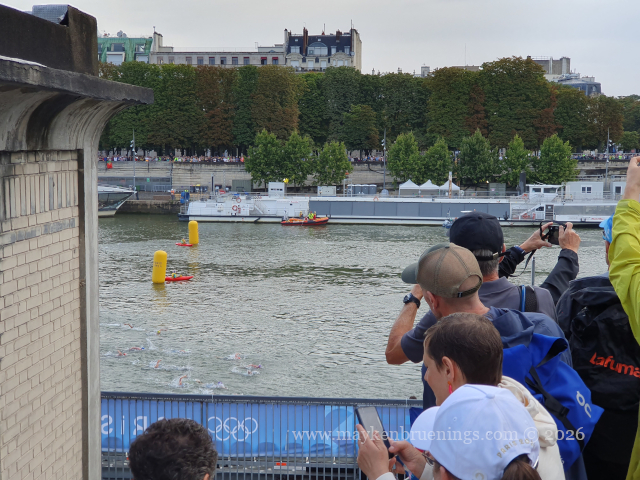
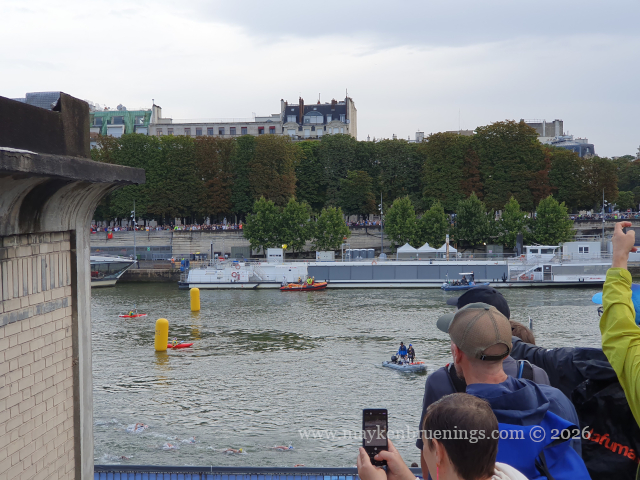
I literally went to see the triathlon on my way to work. Where I stood, we heard the starting signal, then saw the swimmers arrive and round the buoy, repeat this feat and then vanish from sight.
The triathletes have to swim around the yellow buoy.
Here they are in the foreground between the barrier and the first buoy.
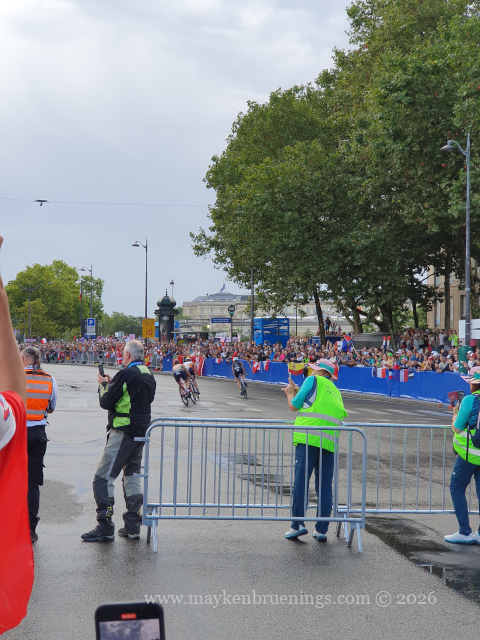
While I made my way through the crowd back onto the street and toward the métro station, the athletes had already finished their first cycling lap and were racing past faster than I could point my camera.
I checked out the running part later on the replay, wondering which of the many colorful swim caps I had seen in the river had been the French triathlete Cassandre Beaugrand who’d gone on to win gold.